Golden Retriever Puppy Treats for Teething and Training
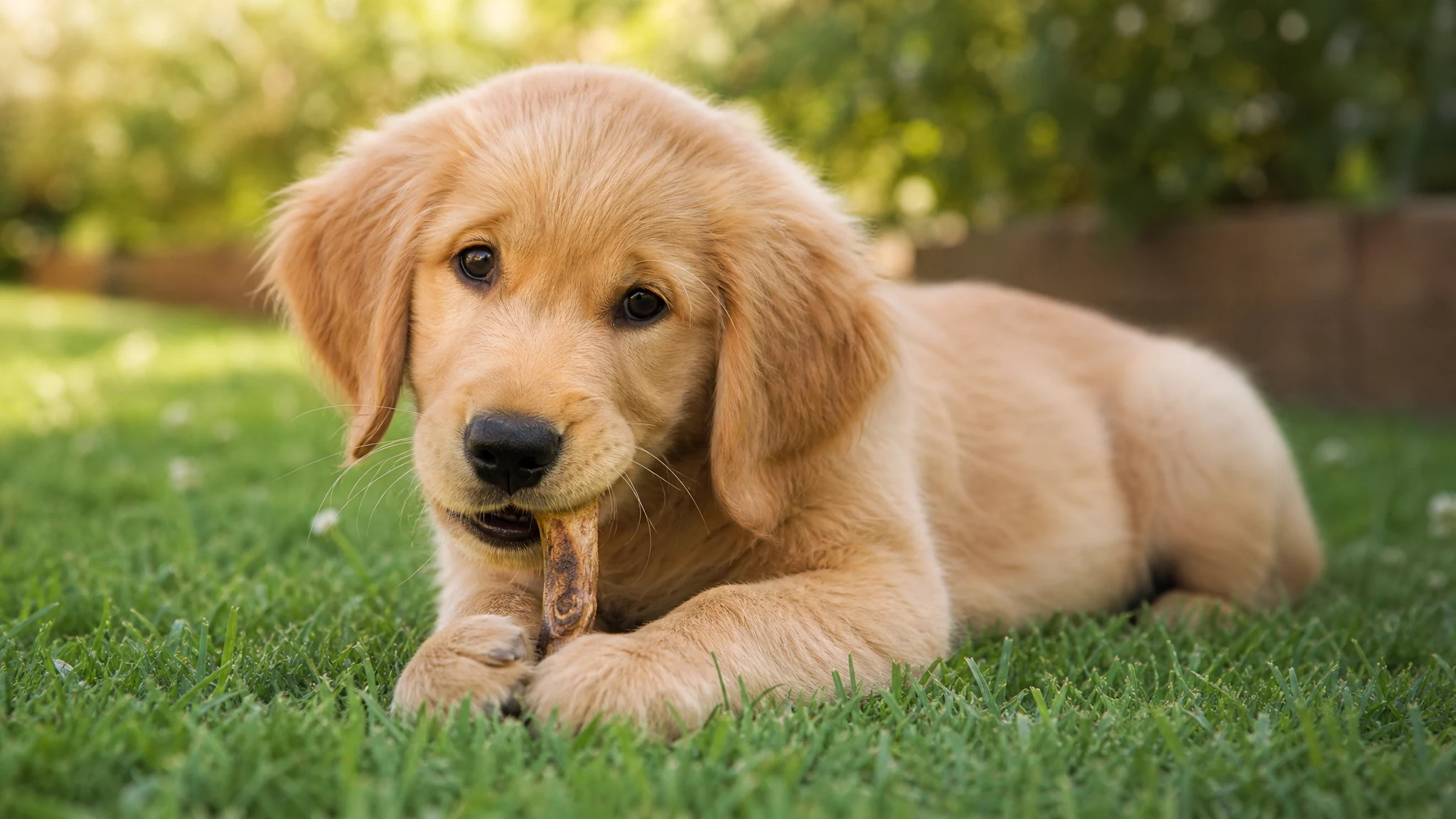
General nutrition information compiled from product labels and published sources, not veterinary advice. Your veterinarian is the right person to choose a diet for your dog, especially one with a health condition.
Golden Retriever puppies chew, mouth and learn fast. That makes treats useful for two jobs: soothing sore gums and rewarding good choices. The trick is doing both without adding extra calories or upsetting a growing body.
This guide shows a simple way to turn your puppy's own food into teething and training treats. It also covers portions, common mistakes and what results to expect.
Why treats need a plan for a Golden Retriever puppy
The Golden Retriever Club of America's breed standard lists adult males at 65 to 75 pounds and females at 55 to 65 pounds. That puts the breed in the large category. Large puppies grow quickly, and growth rate matters.
Cornell University College of Veterinary Medicine says canine hip dysplasia is genetic but is influenced by nutrition and growth rate. It advises avoiding overfeeding in fast-growing large-breed puppies. Cornell also advises against supplementing growing puppies with calcium and vitamin D.
For treats, this means two things. Treat calories count toward the day's total. And treats should not be a back door for extra mineral supplements or rich table scraps.
What you need
- Your puppy's regular large-breed puppy food, dry or canned.
- Warm water.
- A silicone ice cube tray or a hollow rubber chew toy sized for a large puppy.
- A small treat pouch for training sessions.
- A kitchen scale or a measuring cup, so you can count what goes in.
- Your veterinarian's phone number, for questions about your puppy's daily amount.
Start with the right base food. A growth formula should carry an AAFCO nutritional adequacy statement. For dogs expected to reach 70 pounds or more, the statement should end with "including growth of large size dogs (70 lb. or more as an adult)." The Washington Administrative Code, which adopts the AAFCO model, sets out this wording. A statement that ends "except for growth of large size dogs" does not meet the large-size levels.
Our ranked guide to puppy food for Golden Retriever puppies compares label data for several foods if you are still choosing one.
Step 1: Set the daily food budget first
Before you make anything, decide how much of the day's food will become treats. Start from the feeding guide on your puppy's food label. Brands describe these amounts as starting points. Hill's, for example, says to adjust amounts to maintain optimal weight and to ask your veterinarian if you are unsure.
Ask your veterinarian what share of the day's food can be treats for your puppy. Then take that amount out of the meals so the total stays steady. Do not add treats on top of full meals.
Calories per cup differ a lot between foods, so check your own label. The brand pages list, for example, 349 kcal per cup for Royal Canin Large Puppy and 387 kcal per cup for Hill's Science Diet Puppy Large Breed. A "handful" of one food is not the same as a handful of another.
Step 2: Make frozen teething treats from your puppy's food
Cold can feel good on gums. This version uses only food your puppy already eats.
- Measure the kibble. Take the portion you set aside in Step 1 from the day's food.
- Soak it. Cover the kibble with warm water and let it soften for 15 to 20 minutes. It should be soft but not mushy.
- Fill the tray. Spoon the softened kibble and a little of the soaking liquid into the tray cells or into the rubber toy.
- Freeze. Leave it for several hours, until solid.
- Serve under supervision. Offer one on a rug or a surface that is easy to clean. Take it away once it is small enough to swallow whole.
If your puppy eats canned food, you can spread a small amount of it inside the rubber toy and freeze that instead. Count it as part of the meal.
Step 3: Prepare training treats
Training rewards should be tiny. Your puppy cares about getting something fast, not about the size of it.
- Use plain kibble. Pull the day's training portion from your puppy's regular food. Many puppies work happily for their own kibble.
- Keep pieces small. If the kibble is large, break each piece in half. A small piece is quick to swallow, so your puppy stays focused.
- Keep a ranking. Use plain kibble for easy skills at home. Save a higher-value reward, such as a small piece of your puppy's softened or canned food, for distracting places.
- Pouch it up. Put the portion in a pouch so you can reward within a second or two of the right behavior.
Step 4: Use the treats with reward-based training
The American Veterinary Society of Animal Behavior supports reward-based training. That means rewarding what you want and not punishing what you do not. Keep sessions short, a few minutes at a time.
- Say a marker word such as "yes," then deliver the treat.
- Reward sits, calm settling and coming when called while the habit is new.
- Give the frozen treat during quiet time, such as when guests arrive or after a play session. This gives teething energy an acceptable outlet.
- When a behavior is reliable, reward it every other time, then less often. Praise and play can fill the gaps.
Tips that make treats work better
- Rotate chew options. A frozen treat, a puppy-safe rubber toy and a damp, knotted cloth give different textures. Supervise all of them.
- Size matters. Pick items large enough that your puppy cannot swallow them whole.
- Change one thing at a time. Add a new treat on its own so you can tell if it upsets your puppy's stomach.
- Keep a daily tally. Write down the treats given. It is easy to lose count when several family members are rewarding the puppy.
- Watch body shape. If your puppy is gaining faster than your veterinarian expects, ask about reducing treats and meals.
Common mistakes to avoid
- Adding treats on top of full meals. This is the easiest way to overfeed, and Cornell warns against overfeeding fast-growing large-breed puppies.
- Adding calcium or vitamin D. Cornell advises against supplementing growing puppies with these. Calcium-rich chews or powders are not a teething aid.
- Treating a sore mouth as a food problem. If your puppy has swollen gums, bleeding, bad breath or refuses food, call your veterinarian.
- Switching the main food to match the treat. The main diet should remain a growth formula suited to large dogs. Treats are extras.
- Using treats to calm a puppy who is frightened. Rewards are for behaviors you want. Fear needs a veterinarian or a qualified reward-based trainer.
- Leaving a puppy alone with a chew. Chunks can break off. Stay nearby.
What results to expect
Frozen treats may help your puppy settle and give chewing a target, which could mean fewer nibbles on hands and furniture. Results vary from puppy to puppy, and they do not replace puppy-proofing the house.
Consistent small rewards may help your puppy learn skills faster. A puppy who is rewarded within a second or two usually connects the reward with the behavior more easily. Many Golden Retriever puppies are eager to please, but each one learns at a different pace.
Watching the portions also helps you keep your puppy at a healthy weight while growing. Cornell recommends this for large breeds. It does not guarantee any health outcome, and your veterinarian decides what is right for your individual dog.
How long to keep feeding a puppy formula
PetMD suggests feeding a large-breed puppy formula until about 12 to 18 months of age, depending on your veterinarian's advice. Cornell's page on panosteitis, a bone pain condition of young large dogs that lists Golden Retrievers as predisposed, recommends a commercial large-breed puppy diet formulated to an AAFCO growth statement. Ask your veterinarian when to move to an adult food, and keep treat plans in step with that change.
A note on treat labels
We have not named any packaged treats here, because we did not compare treat labels. If you buy treats, check the brand's own website for calories per treat and for the ingredient list. If the information is missing, ask the brand directly. Count the calories the same way you would count a meal.
Sources
- Golden Retriever Club of America, Official Standard of the Golden Retriever
- Cornell University College of Veterinary Medicine, Canine hip dysplasia (CHD)
- Cornell University College of Veterinary Medicine, Panosteitis in dogs
- Washington Administrative Code 16-252-044 (adopts the AAFCO model), via Cornell LII
- PetMD, Golden Retriever Dog Breed Health and Care
- Royal Canin, Large Puppy dry dog food
- Hill's Pet Nutrition, Science Diet Puppy Large Breed Chicken & Brown Rice Recipe