Golden Retriever Puppy Growth Chart: Weight by Month and What Food Has to Do With It
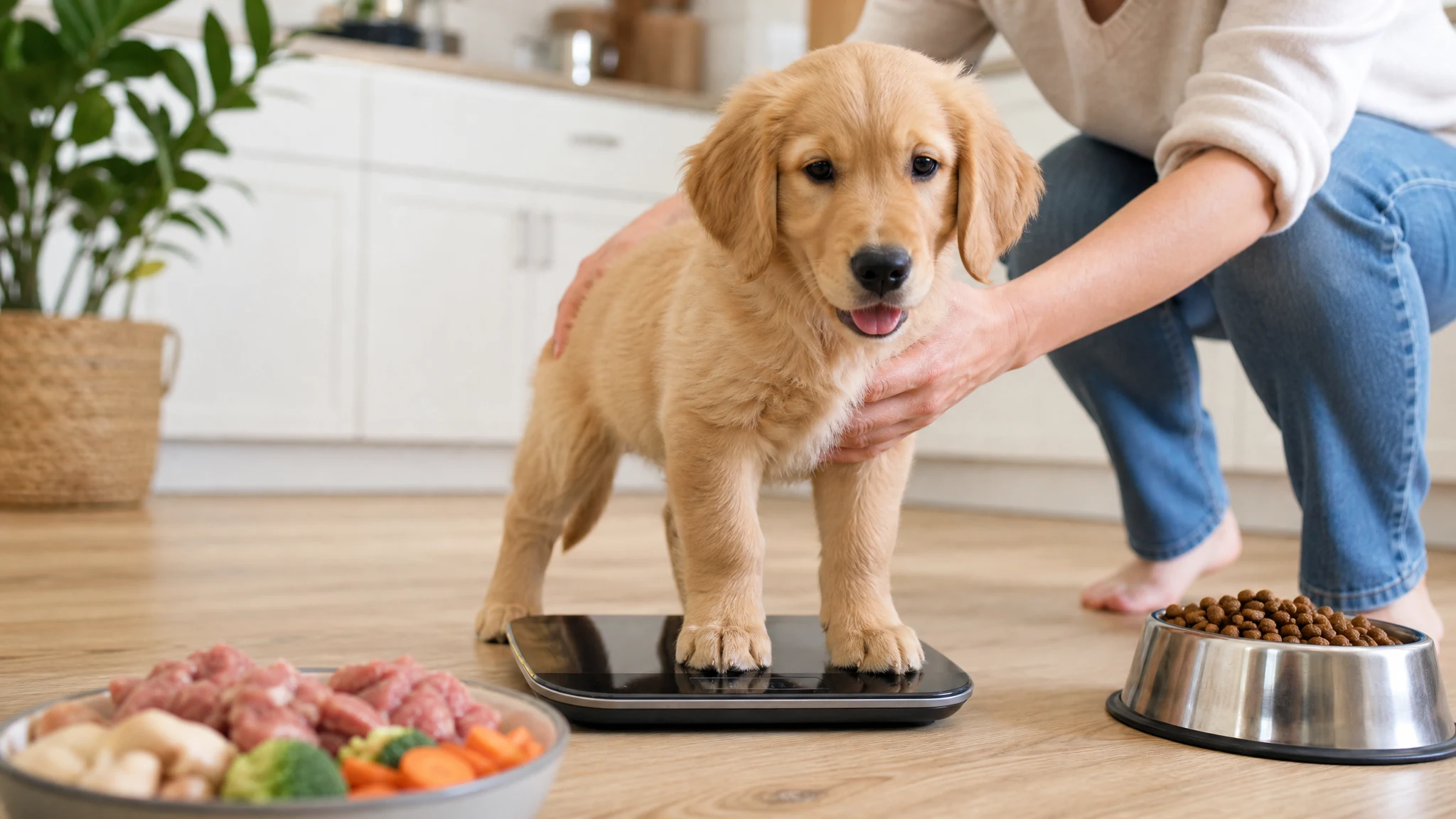
General nutrition information compiled from product labels and published sources, not veterinary advice. Your veterinarian is the right person to choose a diet for your dog, especially one with a health condition.
Most owners looking for a golden retriever puppy growth chart want one thing: a number to compare their puppy against. This guide gives you the numbers that are published, says plainly where none exist, and shows you a better way to judge growth than a scale alone.
A puppy's weight matters. But the shape of the body and the pace of growth tell you more. For a large, fast-growing breed, pace is where food choices count most.
Key Takeaways
- The Golden Retriever Club of America breed standard gives adult weights: males 65 to 75 pounds, females 55 to 65 pounds.
- We did not find breed-specific, month-by-month weight figures from a club, vet school or regulator. Any exact monthly chart you see should be treated with caution.
- Cornell University's College of Veterinary Medicine says overfeeding and rapid growth can worsen hip dysplasia in predisposed dogs.
- Check body shape (ribs, waist, tuck) at every stage. A lean, steady puppy is the goal, not the biggest puppy in the class.
- Choose a growth formula whose label says it covers growth of large size dogs, and treat the feeding guide as a starting point.
Table of Contents
- What the breed standard tells us about adult size
- Golden retriever puppy weight by month: what is and is not known
- How to read your puppy's body condition
- Why overfeeding is the bigger risk
- How growth formulas are built for large puppies
- Reading a label and a feeding guide
- When to move to adult food
- Questions owners ask
What the Breed Standard Tells Us About Adult Size
The Golden Retriever Club of America publishes the Official Standard of the Golden Retriever. It says males should weigh 65 to 75 pounds and females 55 to 65 pounds. Height at the withers is 23 to 24 inches for males and 21 1/2 to 22 1/2 inches for females.
That is the end point of your puppy's growth. Everything on a golden retriever puppy weight chart is just a path toward that range.
Why this puts Goldens in the large-breed group
Dog food labels use a size line of 70 pounds as an adult. The standard's upper male weight of 75 pounds sits above that line. Female weights sit below it. So a Golden can land on either side, and a male can easily end up above it.
Because you cannot know your puppy's final size at eight weeks, a large-size growth formula is the safer fit. That is a practical reading of the numbers, not a rule from any single source.
A range, not a promise
Individual dogs vary. A puppy that ends at 62 pounds is not behind. A puppy that reaches 80 pounds is not automatically healthy just because it is bigger. The standard describes the breed, and your veterinarian judges your dog.
Golden Retriever Puppy Weight by Month: What Is and Is Not Known
Here is the honest part. We looked for a monthly golden retriever puppy weight chart from the breed club, a veterinary school or a regulator. We did not find one. The sources we relied on give the adult weight range and growth guidance, but not month-by-month figures for the breed.
Many websites print neat tables with a weight for every month. Without a named source, those numbers are averages of unknown origin. A puppy who sits outside them may be perfectly healthy.
What we can offer is a stage-by-stage framework. It uses only the published adult range and the growth guidance from Cornell University's College of Veterinary Medicine.
| Stage | What is published | What to do |
|---|---|---|
| Early puppyhood (first months) | No breed-specific monthly weights found. Growth is fast. | Feed a large-breed growth formula. Weigh at regular intervals and keep a log. Ask your veterinarian to review the trend. |
| Middle growth (the months before adolescence) | No breed-specific monthly weights found. Cornell says avoid overfeeding and rapid growth. | Judge by body shape. Adjust portions if ribs are hard to feel or the waist disappears. |
| Late growth (toward 12 to 18 months) | PetMD says to feed a large-breed puppy formula until 12 to 18 months, depending on the veterinarian's recommendation. | Ask your veterinarian when to switch to adult food. |
| Adult | Males 65 to 75 pounds, females 55 to 65 pounds (breed standard). | Keep a healthy weight through life. |
Notice that the table has no monthly pound figures. That is deliberate. If you want a personal chart, you can build one: weigh your puppy on the same scale at regular intervals, write down the date and weight, and bring the log to each vet visit. Your own puppy's curve, read by someone who has examined the dog, is more useful than any average.
How to weigh a puppy at home
Use a bathroom scale. Weigh yourself, then weigh yourself holding the puppy, and subtract. Do it at the same time of day, ideally before a meal. Once the puppy is too big to carry, your veterinary clinic can usually tell you whether weigh-ins are welcome.
What a growth spurt looks like
Puppies do not grow in a straight line. A flat week followed by a jump is normal. A puppy that suddenly gains much faster than the weeks before is worth mentioning to your veterinarian, especially on a calorie-dense diet.
How to Read Your Puppy's Body Condition
Because there is no published monthly target, body condition is your best everyday tool. It is a hands-on check of fat cover. Veterinarians commonly use a body condition score for it, and your veterinarian can show you how they score your puppy.
Here is a simple home version. Do it every week or two.
- Feel the ribs. Run your hands along the sides of the chest. You should feel the ribs under a thin layer, like the back of your hand with fingers flat. If you must press hard to find them, there is too much cover.
- Look from above. Stand over your puppy. You should see a waist behind the ribs. A straight or bulging outline means extra weight.
- Look from the side. The belly should tuck up from the chest toward the hind legs. A belly that hangs level or low is a flag.
- Check the back and hips. You should be able to feel the spine without it being sharp. Bony, prominent hips can mean too thin.
Golden coats are thick, especially as they mature, so use your hands as well as your eyes. A fluffy puppy can hide a lot.
If your puppy looks too thin
Do not jump to a richer diet or add supplements. Growing puppies should not get extra calcium or vitamin D, according to Cornell's guidance on growing dogs. See your veterinarian first, since thinness can have causes unrelated to food, such as parasites.
Why Overfeeding Is the Bigger Risk
Owners often worry that their puppy is too small. For a large breed, the more common concern runs the other way.
Cornell University's College of Veterinary Medicine describes canine hip dysplasia as genetic, but modified by nutrition and growth rate. In dogs predisposed to it, overfeeding and rapid growth can make it worse. Cornell advises avoiding overfeeding fast-growing large-breed puppies and keeping a healthy weight through life.
PetMD lists hip dysplasia among conditions seen in Golden Retrievers and describes it as inherited. Cornell's page does not name Goldens, so we are drawing on both sources here.
No food prevents or treats hip dysplasia. What the source says is narrower: how fast a predisposed puppy grows can matter. A veterinarian decides what is right for an individual dog.
Growing bones
Cornell also lists the Golden Retriever as a breed predisposed to panosteitis, a growing-bone pain seen in young large-breed dogs. Its recommendation is a commercial large-breed puppy diet formulated to an AAFCO growth statement. If your puppy limps or seems sore, that is a veterinary visit, not a diet experiment.
Where extra calories hide
- Training treats. A busy training day can add a lot. Count them, or take them from the meal portion.
- Chews and table scraps. These add up quickly for a small puppy.
- Free feeding. A full bowl all day makes portions impossible to track. Measured meals are easier to adjust.
- Toppers and mix-ins. Extra food on top of a complete diet adds calories and can unbalance it.
If you use food for reward-based training, which is the humane approach recommended by the American Veterinary Society of Animal Behavior, use small pieces and subtract them from the day's meals.
How Growth Formulas Are Built for Large Puppies
Not every puppy food is made for a dog that will weigh 55 to 75 pounds. The wording of the nutritional adequacy statement tells you which is which.
Under the AAFCO model adopted in Washington Administrative Code 16-252-044, a food claiming Growth or All Life Stages must end its statement one of two ways. It says either "including growth of large size dogs (70 lb. or more as an adult)" or "except for growth of large size dogs (70 lb. or more as an adult)." The first means the food meets the large-size nutrient levels. The second means it does not.
For a Golden, look for "including." We did not confirm the specific calcium limit behind that claim on a primary page, so we will not quote one. If you want to know how a brand meets it, ask the brand.
What the label data show
The table below uses label data from the brand pages. It is a small sample, not a full market list. Calories per cup matter because a more calorie-dense food means a smaller cup for the same energy.
| Food | Large-size growth wording found | Calories as listed |
|---|---|---|
| Royal Canin Large Puppy (dry) | Growth including large size dogs (70 lb. or more as an adult) | 349 kcal ME per cup, as fed (calculated) |
| Royal Canin Golden Retriever Puppy (dry) | We could not find an adequacy statement on the page. Check with the brand. | 339 kcal ME per cup, as fed (calculated) |
| Hill's Science Diet Puppy Large Breed Chicken & Brown Rice (dry) | Page states AAFCO feeding tests substantiate complete and balanced nutrition for growing puppies. The page is sold as large breed. | 387 kcal per cup |
| Victor Classic Hi-Pro Plus Large Breed Puppy (dry) | All Life Stages, with the page also covering growth of large dogs. The full sentence was not captured. | 365 kcal per cup |
| Freshpet Multi-Protein Puppy Recipe with Green Beans & Carrots (fresh) | Growth, including growth of large size dogs (70 lbs or more as an adult) | 241 kcal per cup |
Read the gaps as carefully as the numbers. A breed-named food is not automatically a large-size growth food on paper, and a food can be sold as large-breed without the full wording being visible on its page. When it is missing, check with the brand.
The brand pages are the places to confirm details: Royal Canin Large Puppy, Hill's Science Diet Puppy Large Breed, and Victor Hi-Pro Plus Large Breed Puppy.
For a fuller comparison, see our ranked guide to puppy food for Golden Retriever puppies. We compared label data only. We did not run feeding trials or taste tests, and we did not feed any of these foods to dogs.
Reading a Label and a Feeding Guide
Start with the adequacy statement, then the calories, then the feeding guide.
- Adequacy statement. Look for growth or all life stages wording that includes large size dogs.
- Calories. Compare kcal per cup, not just cup counts. A 387 kcal cup and a 339 kcal cup are not the same meal.
- Ingredients. The first five ingredients show what the food leads with. They do not tell you quality or how a dog will do on it.
- Feeding guide. Treat it as a starting point, then adjust to body condition.
The brands themselves say much the same. Royal Canin's page calls its chart only a guide, and notes that grams are more accurate than cups. Hill's says to adjust amounts to maintain optimal weight and to ask your veterinarian if unsure.
A note on fresh and wet foods
Some fresh foods list calories per kilogram or per package rather than per cup. That makes side-by-side comparison harder, so use the brand's own feeding calculator or ask your veterinarian to help convert.
Grain-free and the DCM question
The FDA investigated a possible link between certain diets and canine dilated cardiomyopathy (DCM). Its notes say Golden Retrievers may be genetically predisposed to taurine deficiency linked to DCM, and that there may be reporting bias for the breed. The FDA's latest update on that page is dated December 23, 2022, and it said it does not plan further public updates until there is meaningful new scientific information.
That is not a verdict on any food. It is a reason to talk with your veterinarian before choosing an unusual diet for a breed with this history.
When to Move to Adult Food
PetMD advises feeding a large-breed puppy formula until 12 to 18 months of age, depending on the veterinarian's recommendation. That window is wide on purpose.
A puppy near the lower end of the female range may be done sooner than a large male. Switching too early or too late are both worth avoiding, so make the call with your veterinarian using the weight log and body condition.
When you do switch, mix the new food in gradually over several days to avoid stomach upset.
Staying lean after growth ends
Cornell's advice to keep a healthy weight through life carries past puppyhood. The habits you build now, such as measured meals and regular body checks, are the ones that keep an adult Golden at a healthy weight. PetMD gives a life expectancy of 10 to 12 years for the breed.
Questions Owners Ask
Is my puppy too small or too big?
Without a published monthly chart for the breed, the weight alone cannot answer that. Check body condition, track the trend, and ask your veterinarian.
Can I feed more to help my puppy grow faster?
No. Cornell says to avoid overfeeding and rapid growth in large-breed puppies. Faster is not better.
Should I add calcium?
No. Cornell advises against supplementing growing puppies with calcium and vitamin D. A complete growth formula already covers it, and your veterinarian can advise on anything beyond that.
My puppy has itchy skin. Is it the food?
PetMD notes that Goldens are prone to atopic dermatitis, which is triggered by environmental allergens. That page does not show it as diet-caused. See your veterinarian before changing foods.
What about cancer risk and diet?
The Golden Retriever Lifetime Study enrolled 3,044 dogs and collects diet information by annual owner questionnaire. The published cohort profile draws no diet conclusion, and neither do we.
Sources
- Golden Retriever Club of America, Official Standard of the Golden Retriever
- Cornell University College of Veterinary Medicine, Canine hip dysplasia (CHD)
- Cornell University College of Veterinary Medicine, Panosteitis in dogs
- PetMD, Golden Retriever Dog Breed Health and Care
- Washington Administrative Code 16-252-044 (adopts the AAFCO model)
- FDA CVM, Investigation into potential link between certain diets and canine DCM
- Cohort profile: The Golden Retriever Lifetime Study, PubMed Central
- Royal Canin US, Large Puppy
- Hill's Pet Nutrition, Science Diet Puppy Large Breed
- Victor Super Premium Pet Food, Hi-Pro Plus Large Breed Puppy