Golden Retriever Puppy Diarrhea and Food: What to Know
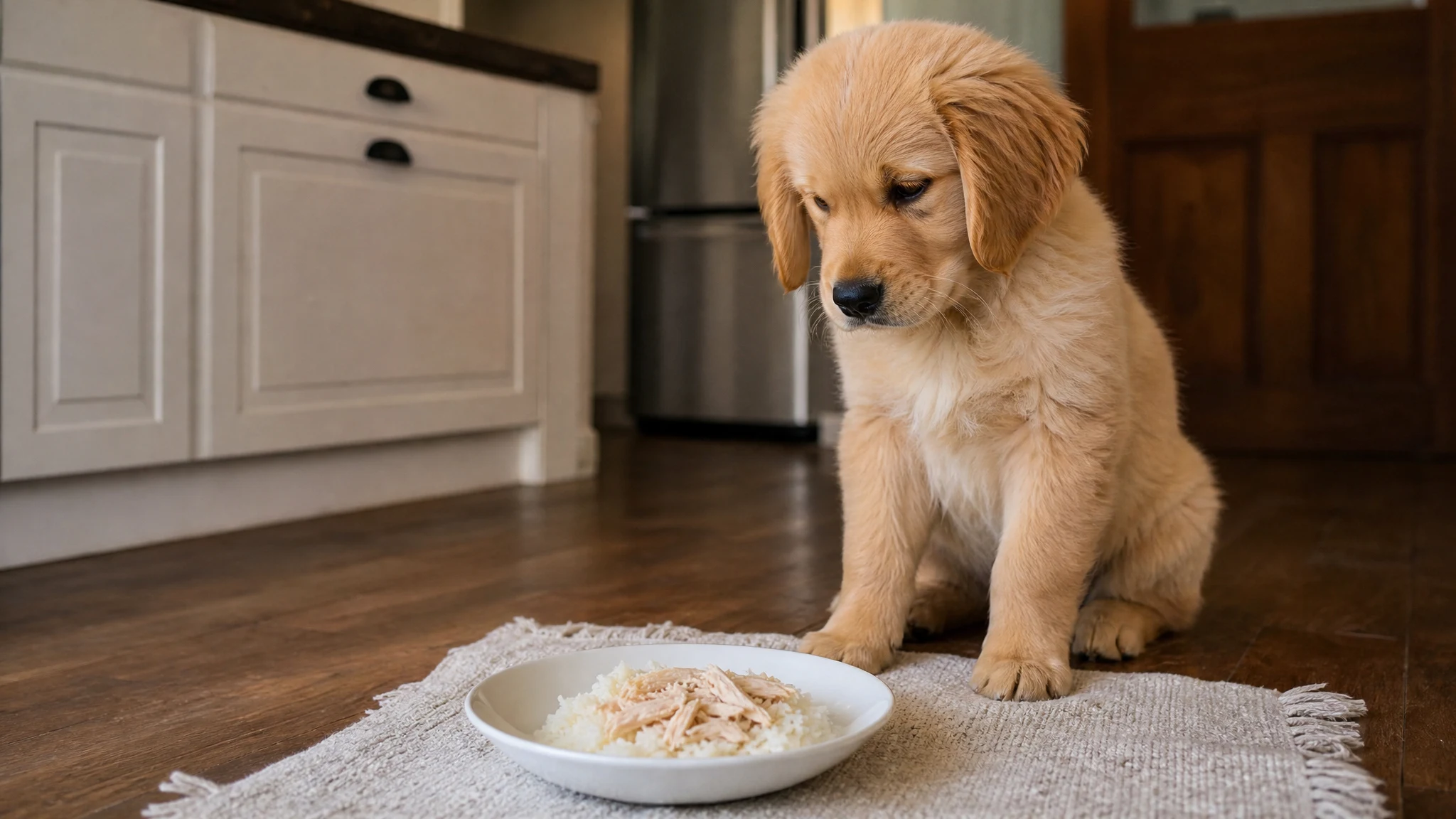
General nutrition information compiled from product labels and published sources, not veterinary advice. Your veterinarian is the right person to choose a diet for your dog, especially one with a health condition.
Loose stools are one of the most common worries for new Golden Retriever owners. Food is one possible factor, but it is not the only one. This guide shows how to look at your puppy's diet calmly, keep useful records, and decide when it is time to call a veterinarian.
It does not diagnose anything, and it does not say any food will stop or fix diarrhea. A veterinarian decides what is going on with an individual puppy.
Why food comes up with a golden retriever puppy diarrhea problem
Puppies have sensitive digestive systems and take in a lot of new things. Food changes, treats, table scraps, chewed objects, parasites and infections can all play a part. Only a veterinarian can sort out which one applies, often with a stool test or an exam.
Golden Retrievers are a large breed. The Golden Retriever Club of America's breed standard puts adult males at 65 to 75 pounds and females at 55 to 65 pounds. Because of that size, vets and nutrition sources focus on growth-appropriate feeding. The goal is a steady growth rate on a diet formulated for large breeds, not the fastest possible growth.
What you need
- The bag or can your puppy is eating now, with the full label, including the nutritional adequacy statement.
- A notebook or phone notes app for a daily log.
- A kitchen scale or the measuring cup you actually use, so amounts are consistent.
- A list of everything else your puppy eats: treats, chews, training rewards, bites of human food.
- Photos of stool, taken when it is safe and easy to do so. Vets often find them useful.
- Your veterinarian's phone number, and the number of an after-hours animal hospital.
Step-by-step: reviewing food when your puppy has loose stools
Step 1: Decide whether this can wait or needs a call today
Start with the puppy, not the food. Call your veterinarian promptly if your puppy seems tired or weak, vomits repeatedly, refuses food or water, has blood in the stool, has a swollen or painful belly, or has diarrhea that keeps going. Young puppies can get dehydrated more quickly than adult dogs, so do not wait and see with a very young or very small puppy.
If your puppy is bright, eating and drinking, and the loose stool is mild, you can move on to the steps below. Still let your vet know, because they may want to guide you.
Step 2: Write down what has changed
Think back over the last several days. Did you switch foods or brands? Add a topper, a new treat or a chew? Did someone share people food? Did your puppy get into the trash or the yard? Did anything stressful happen, such as a move, travel or boarding?
Write each item with a date. Patterns often show up on paper that are hard to see in memory.
Step 3: Read the nutritional adequacy statement
Find the statement on the label. For a Golden Retriever puppy, you want a food that says it meets the AAFCO nutrient profile for growth, or for all life stages, and that the claim covers large-size dogs.
Under the AAFCO model adopted in Washington Administrative Code 16-252-044, foods claiming growth or all life stages must end the statement with either "including growth of large size dogs (70 lb. or more as an adult)" or "except for growth of large size dogs (70 lb. or more as an adult)." The "including" version is the one that fits a Golden Retriever puppy. Cornell University's veterinary college also recommends a commercial large-breed puppy diet formulated to an AAFCO growth statement for breeds prone to growing-bone problems such as panosteitis, a list that includes Golden Retrievers.
If your food says "except for growth of large size dogs," or has no clear statement, bring that up with your vet.
Step 4: Check how much you are feeding
Overfeeding is easy to do with a hungry puppy. Cornell's veterinary college advises avoiding overfeeding and rapid growth in large-breed puppies. Compare what you actually scoop with the feeding guide on the package. Treat the guide as a starting point, because the brands say so themselves. Hill's, for example, tells owners to adjust amounts to maintain optimal weight and to ask a veterinarian if unsure.
Weigh the portions for a few days, count treats as part of the day's food, and ask your vet to check your puppy's body condition at the next visit.
Step 5: Look at the food change history
If you recently switched foods, tell your vet exactly how the switch was done and how long it took. A sudden swap is a common thing for vets to ask about. Do not keep changing foods in a hurry while stools are loose, since that makes it harder to tell what is causing what. Ask your vet whether to stay on the current food, go back to the previous one, or change.
Step 6: Keep the log for several days
Record each meal, each treat, and each stool. A simple note works: time, amount, how firm or loose, anything unusual. Add energy level and appetite. This log is the most useful thing you can bring to an appointment.
Step 7: Bring the label and the log to your vet
Take the bag, or photos of the full label, including the ingredient list and the adequacy statement. Ask directly whether the food suits a growing Golden Retriever, whether a stool test is needed, and what feeding plan to follow until things settle.
How to think about comparing foods
If your vet suggests changing foods, you can compare options using label data. Our approach is to compare what brands publish: the adequacy statement, ingredient order, guaranteed analysis, calories and kibble details. We did not run feeding trials or taste tests, and label data cannot tell you how an individual puppy will do.
Some brands publish a large-breed puppy product that states it covers growth of large-size dogs. Royal Canin Large Puppy, for example, lists that AAFCO growth statement for large-size dogs on its own product page. Several Freshpet puppy recipes make the same large-size growth claim on theirs. Royal Canin also makes a Golden Retriever Puppy formula, but the brand page we reviewed did not show an adequacy statement, so check with the brand before assuming it carries the large-size claim.
Calories vary widely between dry, fresh and canned foods, so a cup of one is not equal to a cup of another. For a ranked look at puppy options, see our guide to the best puppy food for Golden Retriever puppies.
Tips
- Change one thing at a time, so you can tell what made a difference.
- Keep treats to a small share of the day's food, and keep them plain and simple while stools are loose.
- Feed meals at regular times. A steady routine is easier to track.
- Ask your vet before adding probiotics, toppers or home-cooked food.
- Remember that allergies are a separate topic. PetMD notes Golden Retrievers are prone to atopic dermatitis, which is triggered by environmental allergens and is not shown to be caused by diet on that page.
Common mistakes to avoid
- Adding calcium or vitamin D. Cornell's veterinary college advises not supplementing growing puppies with calcium and vitamin D. Never add supplements without veterinary direction.
- Switching foods repeatedly. Rapid rotation muddies the picture.
- Treating a label claim as a medical answer. Marketing words like "sensitive" or "gentle" are not the same as a veterinary diagnosis.
- Using human medicines. Do not give over-the-counter or leftover medication unless your vet says to.
- Waiting too long. Persistent diarrhea or any sign of illness deserves a call.
- Assuming grain-free is safer. The FDA has investigated a possible link between certain diets and canine dilated cardiomyopathy (DCM). Its page notes that Golden Retrievers may be genetically predisposed to taurine deficiency linked to DCM, and that reporting bias for the breed is possible. The latest update on that page was dated December 23, 2022, and the FDA said it did not plan further public updates without meaningful new scientific information. Talk with your vet about diet choices rather than guessing.
What to expect
Many puppies with mild, short-lived loose stools may improve once the trigger, such as a recent change or extra treats, is identified and addressed. Others need a stool test, deworming or other care. No food can be promised to resolve diarrhea, and results vary from puppy to puppy.
A realistic goal is a clearer picture. With a good log and a label review, your veterinarian can more easily work out whether diet, parasites, infection or something else is involved.
Growth matters too. Cornell notes that hip dysplasia is genetic but can be influenced by nutrition and growth rate. For that reason, any diet change for a Golden Retriever puppy should be a decision made with your vet, not a quick fix. PetMD suggests feeding a large-breed puppy formula until about 12 to 18 months, depending on the veterinarian's recommendation.
When to stop and call
If at any point your puppy seems unwell, stop the home review and call. Prescription or therapeutic diets are something only a veterinarian can prescribe, so ask about them rather than buying one on your own.
Sources
- Washington Administrative Code 16-252-044 (AAFCO model), via Cornell LII
- Cornell University College of Veterinary Medicine, Canine hip dysplasia
- Cornell University College of Veterinary Medicine, Panosteitis in dogs
- Golden Retriever Club of America, Official Standard of the Golden Retriever
- FDA CVM, Investigation into potential link between certain diets and canine DCM
- PetMD, Golden Retriever Dog Breed Health and Care
- Royal Canin, Large Puppy dry dog food
- Hill's Pet Nutrition, Science Diet Puppy Large Breed