Bowl Manners and Food Guarding: Mealtime Training for a Golden Retriever Puppy
General nutrition information compiled from product labels and published sources, not veterinary advice. Your veterinarian is the right person to choose a diet for your dog, especially one with a health condition.
Most Golden Retriever puppies love food. That is useful for training, but it can also lead to gulping, bowl stiffness or a growl when someone walks past. Golden Retriever puppy food aggression and puppy food guarding are worth taking seriously, and they are also very workable when you start early.
This guide walks through a calm, reward-based routine. It uses the daily meal as training time, so you are not adding extra calories. Nothing here uses force, intimidation or punishment.
First, what food guarding looks like
Food guarding is a dog's way of saying "please do not take this." Early signs are easy to miss:
- Freezing or going very still over the bowl
- Eating faster when you come near
- Stiff body, hard stare or a lowered head
- Curled lip, growl, snap or lunge
A growl is information, not bad behavior. Punishing it can teach a puppy to hide the warning and skip straight to a bite. The American Veterinary Society of Animal Behavior (AVSAB) recommends reward-based training and advises against punishment-based methods, and every step below follows that approach.
Materials you will need
- Your puppy's regular measured meal, split into portions
- A handful of small, soft treats that your puppy finds special (set aside part of the daily food allowance for these)
- A plain bowl, plus a slow feeder, lick mat or snuffle mat if your puppy gulps
- A quiet corner or crate area, away from foot traffic
- A baby gate or exercise pen to keep children and other pets away
- A treat pouch or small container
- A measuring cup or kitchen scale
A note on food and portions
Mealtime training works best when portions are steady. Cornell University College of Veterinary Medicine advises using a diet formulated for large breeds while puppies are growing, and avoiding overfeeding and rapid growth. It also advises against adding calcium and vitamin D to a growing puppy's diet. The Golden Retriever Club of America's breed standard puts adult males at 65 to 75 pounds, so a Golden is a large-breed puppy.
On a package, look for the AAFCO statement. For large dogs it should end with "including growth of large size dogs (70 lb. or more as an adult)," as the Washington Administrative Code 16-252-044 adopts from AAFCO. Our ranked comparison of puppy foods for Golden Retriever puppies covers how we compared label data. We did not run feeding trials or taste tests.
Use the feeding guide on the bag as a starting point only. Your veterinarian can adjust it for your puppy's body condition. PetMD notes that large-breed puppy formulas are generally fed until 12 to 18 months of age, depending on the veterinarian's recommendation.
Step-by-step: building bowl manners
Step 1. Set up a calm feeding spot
Pick one quiet place and use it every meal. A corner of the kitchen with a gate, or a crate, works well. Keep other pets and children out while your puppy eats.
A puppy who feels safe has less reason to guard. Predictable timing helps too. Set meals at the same times each day, and pick the bowl up when the puppy finishes rather than leaving it down all day.
Step 2. Ask for a sit before the bowl goes down
Hold the bowl at chest height. Wait for the puppy to sit, even for one second, then lower the bowl and say "okay." Sitting is rewarded with dinner, so you are teaching that calm behavior makes food appear.
If your puppy jumps or lunges, simply stop and wait. Do not push or scold. Most Golden puppies work out the pattern within a few meals.
Step 3. Hand-feed part of the meal
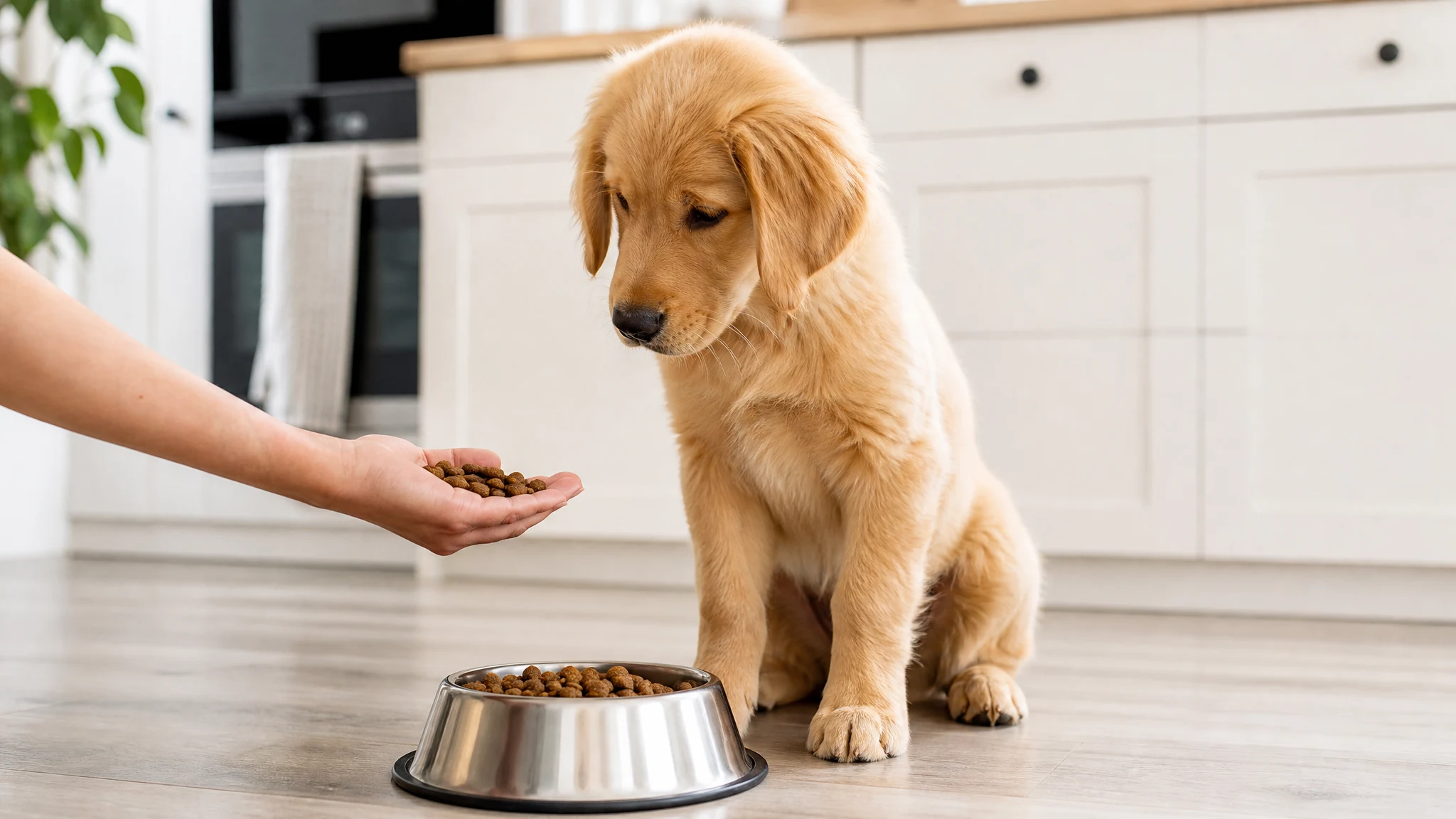
For the first week or two, give a portion of each meal from your hand. Put a few kibbles in your palm and let your puppy eat them. Then repeat.
This builds a simple association: hands near food mean good things. It also slows eating and gives you daily practice at being close to your puppy while they eat.
Step 4. Add to the bowl, do not take from it
Put a small amount of kibble in the bowl. While your puppy eats, walk up, drop one extra treat into the bowl, and walk away. Do this at several points in the meal.
Your approach now predicts something wonderful. Never reach in and grab the bowl. Taking food away teaches a puppy that guarding was right all along.
Step 5. Practice trading up
Trading up means swapping something for something better, so the puppy always comes out ahead. Start with a low-value item such as a dull chew. Offer a tiny, tasty treat near the puppy's nose. When the puppy drops the item to take the treat, say "thank you," then give the item back if it is safe.
Giving it back is important. The puppy learns that giving something up is not a loss. Over weeks, work up to more valued items. Do the same with food, offering a better treat when you need the puppy to leave the bowl.
Step 6. Teach a reliable "leave it" and "drop it"
Practice these away from mealtime first, with low-value objects. Reward every success with a treat. When the puppy is reliable at that level, bring the cues into mealtime.
These cues are also a safety tool for the day your puppy grabs something dangerous off the floor.
Step 7. Let children and visitors help safely
Children should not approach a puppy who is eating, reach for the bowl or hug the puppy during meals. Instead, teach them the "drop a treat and walk on" game, with an adult supervising.
If your puppy ever stiffens, the adult steps in calmly. Supervise every interaction between a young child and a puppy around food.
Slowing down a Golden Retriever puppy who eats too fast
A Golden Retriever puppy eating too fast is common. Gulping can come from excitement, competition with littermates in the past or simple enthusiasm. It is not the same as guarding, but the two can feed each other, because a puppy who gulps often feels hurried and tense.
Practical ways to slow things down:
- Slow feeder bowl. Raised ridges make the puppy work around obstacles. Pick one with a smooth surface and wide channels, and check that it is easy to clean.
- Lick mat or snuffle mat. Spread wet or soaked food on a mat, or scatter kibble in a snuffle mat. Both add a bit of mental work to the meal.
- Scatter feeding. Toss kibble across a clean floor or into grass. Sniffing and searching naturally slow eating.
- Puzzle toys. Food-dispensing toys turn dinner into a game. Start with easy ones so your puppy does not get frustrated.
- Smaller, more frequent meals. Splitting the same daily amount across more meals can reduce the rush. Ask your veterinarian how many meals suit your puppy's age.
If gulping is followed by vomiting, retching, a swollen belly or discomfort, contact your veterinarian. Do not wait. Your vet can tell you whether it is simple speed or something that needs attention.
Make meals into training time
Instead of putting the bowl down and leaving, use part of the meal for short lessons. Carry the kibble in a pouch and reward:
- Sit and down
- Eye contact
- Coming when called
- Walking beside you on a loose leash in the yard
Keep sessions to a few minutes. Golden puppies tend to be eager to work for food, so this is an easy way to use their enthusiasm. Because the training food comes out of the day's portion, it does not add calories, which matters for a large-breed puppy who should not be overfed, per Cornell.
Common mistakes to avoid
- Taking the bowl away mid-meal. It teaches the puppy to guard harder.
- Punishing a growl. This can remove the warning without removing the worry.
- Using dominance myths. Pinning, scruffing or "alpha" tactics are not part of reward-based training and can make fear and guarding worse.
- Feeding amid chaos. A busy hallway or a crowd of children invites tension.
- Adding treats on top of full meals. Extra calories can speed growth. Take training food from the daily allowance.
- Rushing the steps. Move on only when your puppy is relaxed at the current level.
- Adding supplements to help growth. Cornell advises against calcium and vitamin D supplements for growing puppies.
Expected results
With patient, consistent practice, many puppies become more relaxed around the bowl over several weeks. Gulpers often eat more slowly with a slow feeder or scatter feeding. Results vary between puppies and cannot be promised, and some puppies need more time or more help than others.
Keep practicing as your puppy grows. Guarding can show up or return during adolescence, so keep dropping treats into the bowl and trading up even after things look good.
When to call a professional
Reach out to your veterinarian and a qualified, reward-based behavior professional if you see any of these:
- Snapping, lunging or biting over food or objects
- Guarding that is getting worse despite steady practice
- Guarding of people, spaces or toys as well as food
- A sudden change in appetite or eating behavior, which can have medical causes
- Anyone in the home feeling unsafe
Start with your veterinarian to rule out pain or illness. Then ask about a veterinary behaviorist or a certified behavior consultant who uses reward-based methods. Check credentials with the certifying organization yourself, and avoid anyone who recommends shock, prong or choke collars, alpha rolls or dominance techniques.
Quick routine recap
- Feed in a calm, gated spot at set times.
- Ask for a sit before the bowl lands.
- Hand-feed part of each meal.
- Drop treats into the bowl and walk away.
- Practice trading up, and give items back.
- Teach "leave it" and "drop it" away from the bowl first.
- Use slow feeders, mats or scatter feeding for gulpers.
- Call your veterinarian and a reward-based professional if guarding escalates.