How Much to Feed a Golden Retriever Puppy: Feeding Chart by Week and Month
General nutrition information compiled from product labels and published sources, not veterinary advice. Your veterinarian is the right person to choose a diet for your dog, especially one with a health condition.
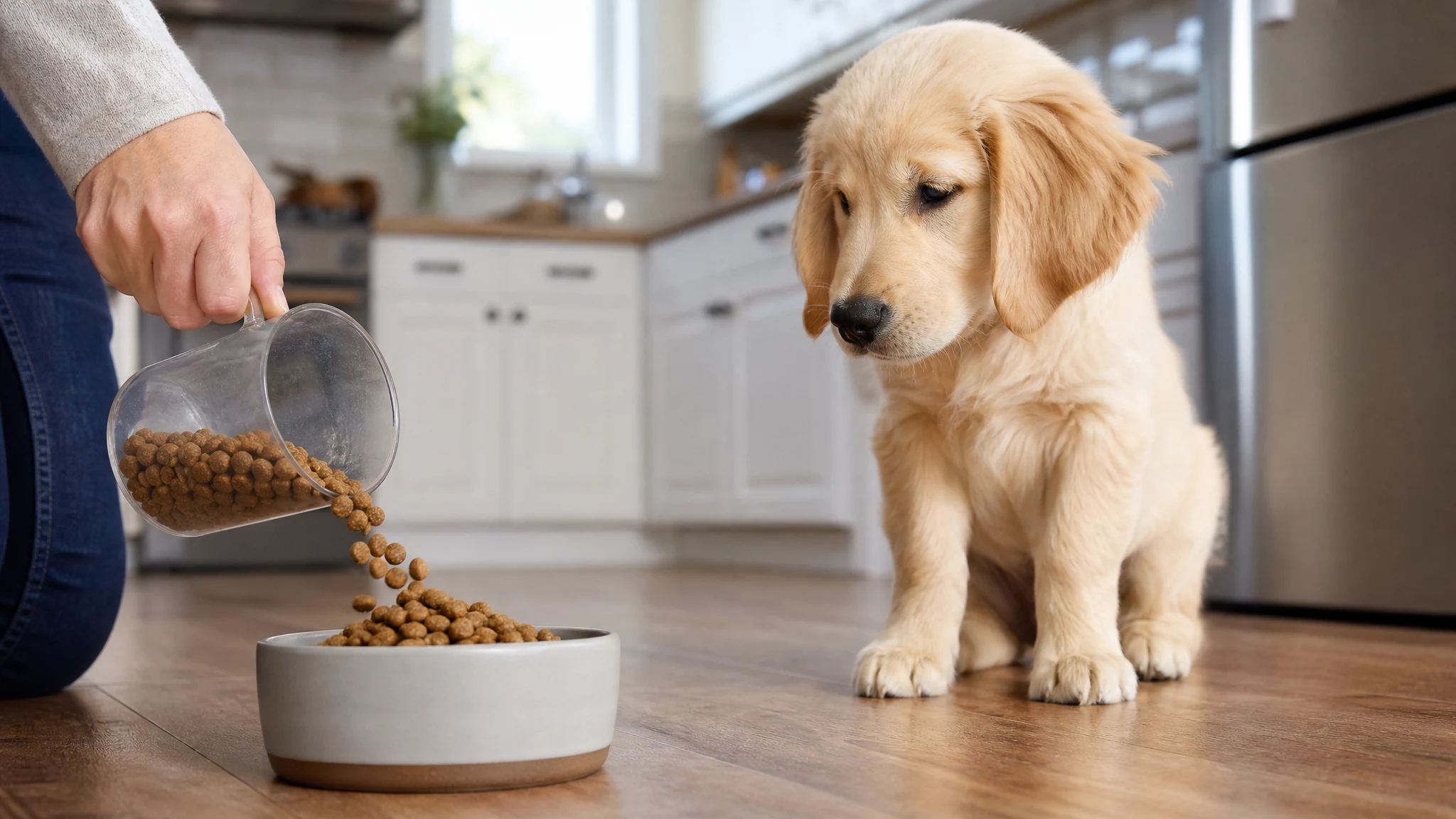
Every owner of a new Golden Retriever puppy asks the same question: how much food is the right amount? The honest answer is that no single number fits every puppy. Two littermates can need different amounts, and the same puppy needs different amounts from one month to the next.
This guide shows you how to build a Golden Retriever puppy feeding chart for your own dog. You will start with the food's label guide, adjust for your puppy's body condition, and recheck as the puppy grows. A simple stage chart and a calorie comparison are included, but the final amounts come from your puppy and your veterinarian.
Why Golden Retriever puppies need a careful approach
The Golden Retriever Club of America breed standard describes adult males at 65 to 75 pounds and adult females at 55 to 65 pounds. That puts the breed in the large category. The upper end of the male range is above the 70 pound cutoff that AAFCO uses for large-size dogs.
A puppy that ends up near 60 to 75 pounds grows quickly, and growth rate matters. Cornell University College of Veterinary Medicine explains that canine hip dysplasia is genetic but can be modified by nutrition and growth rate. It says overfeeding and rapid growth can make it worse in predisposed dogs. PetMD describes hip dysplasia as inherited and lists it among Golden Retriever health concerns.
Cornell's advice for growing large-breed puppies is plain:
- Feed a diet formulated for large breeds while the puppy is growing.
- Do not add calcium or vitamin D supplements to a growing puppy.
- Avoid overfeeding and rapid growth.
Cornell also lists Golden Retrievers as a predisposed breed for panosteitis, a growing-bone pain in young large-breed dogs. It recommends a commercial large-breed puppy diet formulated to an AAFCO growth statement. None of this means a particular amount of food prevents a problem. It means that slow, steady growth is the goal, and a veterinarian decides what is right for an individual dog.
What you need before you start
- The bag, can or package of the puppy food you plan to use, with its feeding guide.
- A kitchen scale that reads in grams. Royal Canin's feeding guide says grams are the most accurate form of measurement and that cup amounts are given to the closest proximity.
- A standard dry measuring cup, if you also want to track cups.
- A bathroom scale or your veterinarian's scale to track your puppy's weight. Weigh yourself, then weigh yourself holding the puppy, and subtract.
- A notebook or phone note for weights, daily amounts and body condition checks.
- The adult weight range from the breed standard: 65 to 75 pounds for males, 55 to 65 pounds for females.
- Your veterinarian's contact details for questions and checkups.
Step 1: Choose a food with the right life stage statement
The feeding chart on a bag only makes sense if the food is built for your puppy. Look for the nutritional adequacy statement, usually in small print near the ingredients.
For a Golden Retriever, the useful wording is that the food is formulated for growth including growth of large size dogs (70 lb. or more as an adult). The Washington Administrative Code, which adopts the AAFCO model rule, says foods claiming Growth or All Life Stages must end the statement with either "including growth of large size dogs (70 lb. or more as an adult)" or "except for growth of large size dogs (70 lb. or more as an adult)." The first meets the large-size nutrient levels. The second does not.
Some examples of how brands word this on their own pages:
- Royal Canin Large Puppy states it is formulated for growth including growth of large size dogs (70 lb. or more as an adult).
- Freshpet's Chicken, Egg, Salmon & Beef Puppy Recipe carries the same large-size growth wording.
- Hill's Science Diet Puppy Large Breed Chicken & Brown Rice says feeding tests using AAFCO procedures substantiate it as complete and balanced for growing puppies. It is sold as a large breed puppy food.
One caution: the Royal Canin Golden Retriever Puppy page we compared shows no AAFCO statement, only a footnote about nutrients. Check the bag in your hands, or ask the brand, before relying on it. The Hill's standard Puppy Chicken & Brown Rice page makes no large-breed calcium claim, so for a Golden the large breed version is the closer fit.
For a side-by-side look at label data, see our comparison of puppy foods for Golden Retriever puppies. We compared label data only. We did not run feeding trials or taste tests.
Step 2: Know the calories in your food
Cups are a poor way to compare foods, because a cup of one food can hold far more energy than a cup of another. The calorie figure on the label tells you how much a cup is worth. Here is what the manufacturers' pages list for a few dry puppy foods:
| Food (dry) | Calories listed on the brand page |
|---|---|
| Royal Canin Golden Retriever Puppy | 339 kcal ME per cup, as fed (calculated) |
| Royal Canin Large Puppy | 349 kcal ME per cup, as fed (calculated) |
| Victor Classic Hi-Pro Plus Large Breed Puppy | 365 kcal per cup |
| Hill's Science Diet Puppy Large Breed | 387 kcal per cup |
| Hill's Science Diet Puppy (standard) | 390 kcal per cup |
See the difference? A cup of the Hill's standard puppy food (390 kcal) carries about 15 percent more calories than a cup of Royal Canin Golden Retriever Puppy (339 kcal). If you switch foods and keep scooping the same number of cups, you may be feeding noticeably more or less than before. Always re-read the new food's guide instead of copying the old amount.
Fresh and canned foods are listed differently. Freshpet's Chicken, Egg, Salmon & Beef Puppy Recipe lists 259 kcal per cup, and its Multi-Protein Puppy Recipe lists 241 kcal per cup. Hill's canned puppy foods list calories per can, not per cup. JustFoodForDogs lists calories per kilogram, per ounce and per 18 ounce pack. Follow the brand's own serving instructions for these.
Step 3: Read the label's feeding guide the right way
Most feeding guides are a grid. One side is your puppy's current weight, and the other side is either age or expected adult weight. The cell where they meet gives a daily amount. Here is how to use it.
- Weigh your puppy today. Use the same scale each time and write the number down.
- Pick your expected adult weight. The breed standard says 65 to 75 pounds for males and 55 to 65 pounds for females. Breeders and veterinarians can estimate where your puppy will land. If the chart has columns like "expected adult weight," choose the column that matches that estimate. If the chart is by age, use the age row closest to your puppy.
- Find the row for the current weight. Read across to the daily amount. This is the total for the day, not per meal.
- Divide the daily total into meals. Ask your veterinarian how many meals suit your puppy at this age. Freshpet notes its puppy recipes can be fed as one meal daily or split into two. A younger puppy often does better with more, smaller meals, but your veterinarian can confirm.
- Convert to grams if you can. Use the grams column if the guide has one, then weigh each meal on the scale.
- Treat the number as a starting point. Hill's says to adjust feeding amounts as necessary to maintain optimal weight, and to ask your veterinarian if you are unsure. That is how most guides should be read.
Some guides are images, not text. The Royal Canin Large Puppy page, for example, has a chart image and tells you to calculate the ideal feeding amount for your pet. JustFoodForDogs also shows its feeding guide as an image. If you cannot read the chart on a website, use the bag, or check with the brand directly.
Step 4: Build your own Golden Retriever puppy feeding chart
Because the numbers must come from your food and your puppy, the chart below shows what to do at each stage rather than a fixed cup amount. Fill in the right-hand column with the amount from your food's guide, then confirm with your veterinarian.
| Stage | What to focus on | Your daily amount |
|---|---|---|
| Weeks 8 to 12 | Start with the food the breeder or shelter used, if your veterinarian agrees. Weigh weekly. Split the day into several small meals as advised. | Label guide for current weight: ______ |
| Months 3 to 4 | Weigh every one to two weeks. The guide amount will change as weight rises, so recheck the row each time. | Label guide for current weight: ______ |
| Months 5 to 6 | Growth is fast for a large breed. Watch body condition closely and do not let the puppy get round. Ask your veterinarian about meal count. | Label guide for current weight: ______ |
| Months 7 to 12 | Keep weighing monthly. Adjust small amounts up or down based on body condition, not on how hungry the puppy acts. | Label guide for current weight: ______ |
| Months 12 to 18 | PetMD says to keep feeding a large-breed puppy formula until 12 to 18 months, depending on the veterinarian's recommendation. Ask when to change to an adult food. | Ask your veterinarian |
The age bands above are a planning tool, not a promise about how your puppy will grow. Individual puppies move through them at different speeds.
Step 5: Adjust by body condition
Weight alone does not tell you whether the amount is right. Body condition does. Check your puppy once a week in good light.
- Ribs: You should be able to feel the ribs easily under a thin layer of coat and flesh, without pressing hard. If you cannot find them, the puppy may be carrying extra weight. If they stick out visibly, the puppy may be too thin.
- Waist: Look down from above. A waist should show behind the ribs.
- Belly: From the side, the belly should tuck up toward the back legs, not hang level or sag.
If the puppy looks a bit round, reduce the daily amount slightly and recheck in a week or two. If the ribs are too prominent, increase slightly. Make small changes and keep notes. Cornell advises avoiding overfeeding fast-growing large-breed puppies and keeping a healthy weight through life, so when in doubt, ask your veterinarian to score your puppy's body condition and tell you the target.
Step 6: Recheck and update every few weeks
A puppy that is fed the same cups for two months is usually being fed too little at the end or too much at the start. Each time you weigh your puppy:
- Write down the new weight.
- Look up the new row in the feeding guide.
- Compare the guide amount with how your puppy looks.
- Adjust the daily total, then split it into meals again.
Treats and chews count too. If you use treats for training, take a little out of the meals so the day's total stays steady. Reward-based training works well with small food rewards, and you can use part of the regular meal as the reward.
Common mistakes to avoid
- Using one fixed number for every puppy. Weight, age, activity and the food's calories all change the answer.
- Feeding by the puppy's begging. Golden Retrievers are often eager eaters. Eagerness is not proof of hunger.
- Adding calcium or vitamin D. Cornell advises against supplementing growing puppies with these. A complete large-breed puppy food already covers them.
- Switching foods and keeping the same cups. As the table above shows, cups differ in calories from food to food.
- Skipping the scale. Scooping by cup can vary a lot from one scoop to the next. Grams are steadier.
- Moving to adult food too early or too late. Ask your veterinarian when your puppy is ready.
- Ignoring treats. Extra calories add up quickly in a small body.
- Treating the label as a prescription. It is a guide. Prescription diets are something only a veterinarian prescribes.
What to expect
If you weigh regularly and adjust in small steps, you may notice steadier growth, a visible waist, and a puppy that feels lean and well muscled. Many owners find that tracking amounts in a notebook makes it easier to talk with their veterinarian about growth.
No feeding plan can promise a particular outcome. Feeding is one part of the picture alongside genetics, exercise, and regular veterinary care. A food does not prevent or treat hip dysplasia, allergies, heart disease or any other condition. Goldens are noted by PetMD as prone to atopic dermatitis, which is triggered by environmental allergens and is not shown on that page to be caused by diet. On heart health, the FDA's page on its canine dilated cardiomyopathy (DCM) investigation notes that Golden Retrievers may be genetically predisposed to taurine deficiency linked to DCM, and also notes reporting bias for the breed. The latest update on that page is dated December 23, 2022, and the FDA said it does not plan further public updates until there is meaningful new scientific information. If you have questions about your dog's diet and heart health, your veterinarian is the right person to ask.
PetMD gives a typical Golden Retriever lifespan of 10 to 12 years. Growing up lean and steady is one way to support the long run, but a veterinarian is the one who can judge your own dog.
When to call your veterinarian
- Your puppy refuses meals for more than a day, or seems low on energy.
- Your puppy is losing weight, or is gaining much faster than the label suggests.
- You see limping, shifting lameness, or pain in the legs while the puppy is growing.
- You are thinking about changing food, adding fresh food, or using any supplement.
- You are unsure whether to move from puppy food to adult food.
Quick recap
- Choose a puppy food whose statement includes growth of large size dogs.
- Check the calories per cup, or the brand's serving instructions.
- Weigh your puppy and find the matching row on the label guide.
- Split the day's amount into meals your veterinarian approves.
- Adjust in small steps by body condition.
- Reweigh and update the chart every few weeks.
Sources
- Golden Retriever Club of America, Official Standard of the Golden Retriever
- Cornell University College of Veterinary Medicine, Canine hip dysplasia (CHD)
- Cornell University College of Veterinary Medicine, Panosteitis in dogs
- Washington Administrative Code 16-252-044, via Cornell LII
- PetMD, Golden Retriever Dog Breed Health and Care
- FDA CVM, Investigation into potential link between certain diets and canine DCM
- Royal Canin, Golden Retriever Puppy dry dog food
- Royal Canin, Large Puppy dry dog food
- Hill's Pet Nutrition, Science Diet Puppy Large Breed
- Hill's Pet Nutrition, Science Diet Puppy
- Victor, Classic Hi-Pro Plus Large Breed Puppy
- Freshpet, Chicken, Egg, Salmon & Beef Puppy Recipe
- Freshpet, Multi-Protein Puppy Recipe