How Much to Feed a Golden Retriever Puppy at 6 Months
General nutrition information compiled from product labels and published sources, not veterinary advice. Your veterinarian is the right person to choose a diet for your dog, especially one with a health condition.
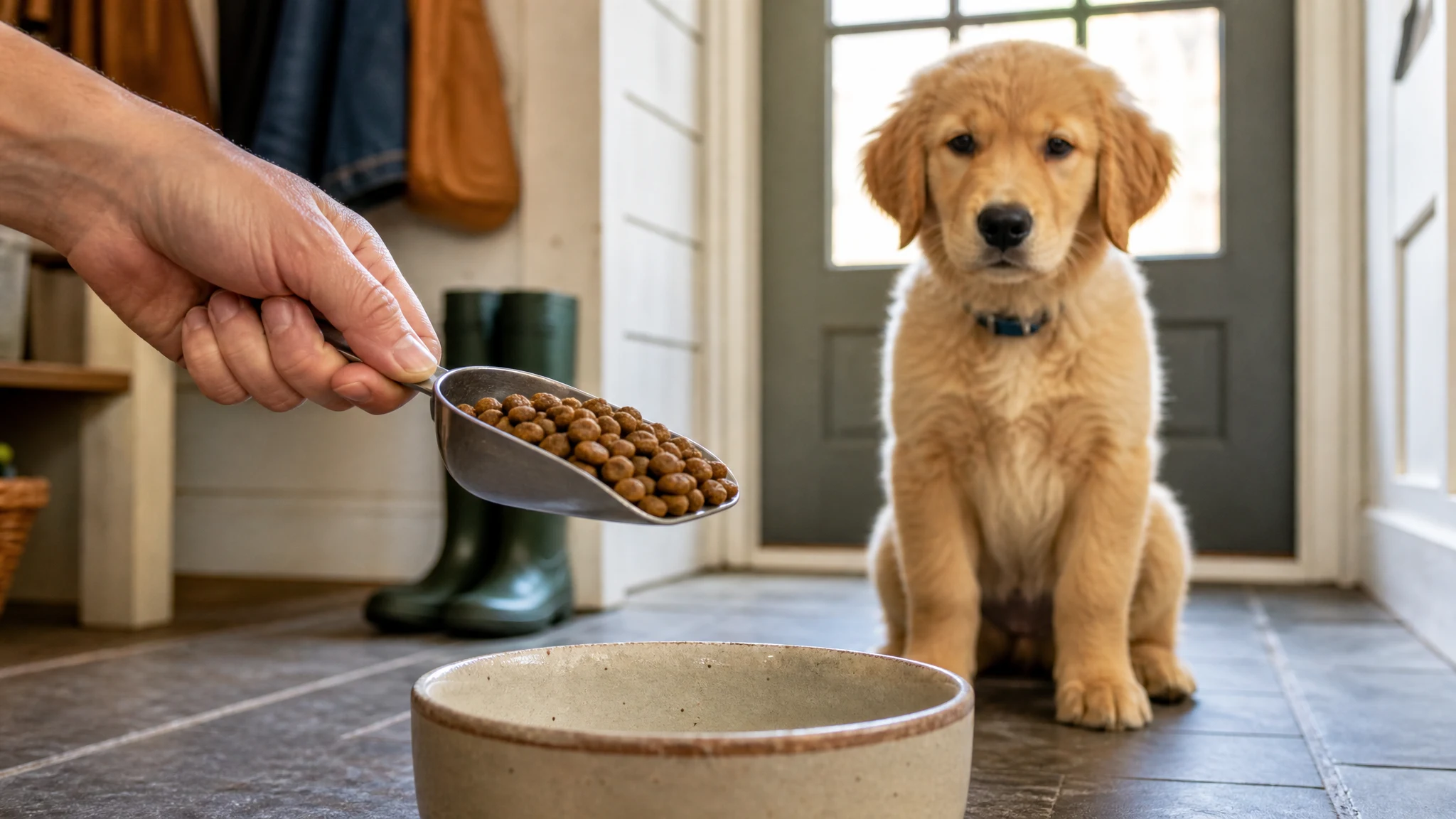
At six months, a Golden Retriever puppy is growing fast and looks nearly grown. The right daily amount of food is not a single number. It depends on the food you choose, your puppy's current weight and how lean or round your puppy looks.
This guide shows a careful way to work out how much to feed a golden retriever puppy, starting from the label on the bag or can and ending with a check-in with your veterinarian. Treat every number you find as a starting point, not a final answer.
Why Golden Retriever puppies need a careful approach
The Golden Retriever Club of America's breed standard lists adult males at 65 to 75 pounds and adult females at 55 to 65 pounds. That puts the breed in the large category, and the top of the male range sits above the 70 pound cutoff that the AAFCO (Association of American Feed Control Officials) uses for large-size dogs.
That matters because large puppies are fed differently from small ones. Cornell University College of Veterinary Medicine says canine hip dysplasia is genetic but is modified by nutrition and growth rate. It notes that overfeeding and rapid growth can make the problem worse in dogs that are predisposed. Cornell advises a diet made for large breeds while puppies grow, no calcium or vitamin D supplements for growing puppies, and avoiding overfeeding.
Cornell also lists Golden Retrievers as a predisposed breed for panosteitis, a growing-bone pain seen in young large-breed dogs. For that, it recommends a commercial large-breed puppy diet formulated to an AAFCO growth statement.
No food prevents or treats these conditions. A veterinarian decides what is right for an individual dog. The point here is simple: steady, lean growth is the goal, not the fastest growth.
What you need before you start
- The bag or can your puppy is eating now, with the full label (not just the front)
- A kitchen scale that measures grams, for the food
- A standard dry measuring cup
- A way to weigh your puppy, such as a vet clinic scale or a home scale (weigh yourself holding the puppy, then subtract your own weight)
- A notebook or phone note to log weight, food amount and treats
- Your veterinarian's phone number for questions
Step 1: Confirm the food is made for large-breed growth
Find the nutritional adequacy statement on the label. For foods that claim growth or all life stages, the AAFCO model rule (as adopted in Washington Administrative Code 16-252-044) says the statement must end in one of two ways. It says either "including growth of large size dogs (70 lb. or more as an adult)" or "except for growth of large size dogs (70 lb. or more as an adult)."
For a Golden Retriever puppy, the "including" wording is the one to look for. If your food says "except," or has no statement you can find, ask the brand or your veterinarian before you rely on it.
Not every label is easy to read. For example, the Royal Canin Golden Retriever Puppy page we looked at did not show an AAFCO statement, only a footnote about nutrients. Check the actual bag, or ask Royal Canin, before you decide.
If you are still choosing a food, our ranked guide to puppy food for Golden Retrievers compares label data side by side. We compared labels only. We did not run feeding trials or taste tests.
Step 2: Weigh your puppy and write down the number
Use the same scale each time and weigh at a similar time of day. Write down the date and weight.
No breed source we used gives a standard weight for a six-month-old Golden Retriever. Puppies vary a lot, so do not compare yours to a chart from a random site. Your veterinarian can tell you whether your puppy's weight and growth curve look right.
For context, the breed standard adult weights above are the end point. Many feeding charts ask for either current weight or expected adult weight, so read the chart's column heads closely.
Step 3: Find the label's feeding guide
Look for the feeding chart on the bag or the brand's product page. Pick the row for your puppy's current weight, or for expected adult weight if that is how the chart is set up. Then write down the daily amount.
Brands present this differently:
- Hill's says to adjust feeding amounts as needed to maintain optimal weight, and to ask your veterinarian if you are unsure.
- Royal Canin says its Golden Retriever Puppy guide is only a guide, and that grams are the most accurate form of measurement, with cups given as a close estimate.
- The Royal Canin Large Puppy page shows its chart as an image and tells you to calculate the ideal amount for your pet.
- Freshpet says to select your dog's weight to see a normal daily amount, and to use the package serving indicators to slice the right amount.
Because charts differ, use the one for the exact food in your bowl, and never borrow a chart from another product.
Step 4: Understand why a cup of one food is not a cup of another
Foods pack different amounts of energy into the same cup. These label figures show the spread:
| Food (large-breed or Golden Retriever puppy) | Calories listed on the brand's page |
|---|---|
| Royal Canin Golden Retriever Puppy (dry) | 339 kcal per cup (calculated) |
| Royal Canin Large Puppy (dry) | 349 kcal per cup (calculated) |
| Victor Classic Hi-Pro Plus Large Breed Puppy (dry) | 365 kcal per cup |
| Hill's Science Diet Puppy Large Breed Chicken & Brown Rice (dry) | 387 kcal per cup |
| Freshpet Multi-Protein Puppy Recipe with Green Beans & Carrots (fresh) | 241 kcal per cup |
This is why you should never switch foods and keep the same cup count. A swap from a 339 kcal cup to a 387 kcal cup quietly adds calories, which is the kind of overfeeding Cornell warns about. Check each brand's own page for current figures: Royal Canin, Hill's, Victor and Freshpet.
Step 5: Weigh the food and split it into meals
Weigh the daily amount in grams if the label gives grams. A cup of kibble can vary with how it is scooped.
Then divide the day's total into the number of meals your veterinarian suggests. Keep meal times steady. Put aside any treats you plan to give, because those calories count too, so take them out of the day's total rather than adding them on top.
Step 6: Check body shape every week or two
The scale is only half the picture. Run your hands along your puppy's sides. You should be able to feel the ribs under a thin layer of padding without pressing hard, and you should see a waist from above. If the ribs are hard to find, or the waist has disappeared, ask your veterinarian whether to trim the amount.
Cornell's advice to avoid overfeeding fast-growing large-breed puppies and to keep a healthy weight through life is the reason for this habit. Small adjustments are safer than big ones.
Step 7: Confirm with your veterinarian and recheck
Bring your weight log and the food label to your next visit. Ask your veterinarian to confirm the daily amount and the number of meals. Do this especially during a growth spurt or if you notice a change in appetite, stool, energy or limping.
Also ask when to move to an adult food. PetMD, a secondary source, says to feed a large-breed puppy formula until 12 to 18 months of age, depending on your veterinarian's recommendation. Your veterinarian makes the final call.
Tips that help
- Change foods slowly and keep the same measuring method each day.
- Use a bowl, not free feeding, so you can see how much is eaten.
- Use part of the daily kibble as training rewards.
- Log every weigh-in, even small changes.
- Read the whole label. Marketing on the front of the bag does not tell you the AAFCO statement.
Common mistakes to avoid
- Using a standard puppy food without checking the large-size statement. A formula that says "except for growth of large size dogs" is not made for this purpose.
- Adding calcium or vitamin D. Cornell advises against supplementing growing puppies with them.
- Counting on the cup, not the gram. Cups can be inconsistent.
- Forgetting treats and chews. They can push total calories up quickly.
- Feeding for a fast growth rate. A bigger puppy is not a healthier puppy.
- Staying on one amount for months. A puppy's needs change as the weight changes.
What results to expect
If the amount is about right, your puppy may keep a visible waist, feel lean over the ribs, have steady energy and gain weight gradually between vet visits. Those are signs worth looking for, not promises. Every dog is different.
Diet is only one part of a Golden Retriever's health. Many conditions in the breed, including hip dysplasia, have genetic causes. The FDA's investigation into diets and canine dilated cardiomyopathy (DCM) notes that Golden Retrievers may be genetically predisposed to taurine deficiency linked to DCM, and that there is reporting bias for the breed. The FDA's last update on that page was dated December 23, 2022, so check the agency's page for anything newer, and ask your veterinarian about it.
Sources
- Golden Retriever Club of America, Official Standard of the Golden Retriever
- Cornell University College of Veterinary Medicine, Canine hip dysplasia (CHD)
- Cornell University College of Veterinary Medicine, Panosteitis in dogs
- Washington Administrative Code 16-252-044 (AAFCO model rule), via Cornell LII
- FDA CVM, Investigation into potential link between certain diets and canine DCM
- PetMD, Golden Retriever Dog Breed Health and Care