Golden Retriever Puppy Feeding Chart by Age and Expected Adult Weight
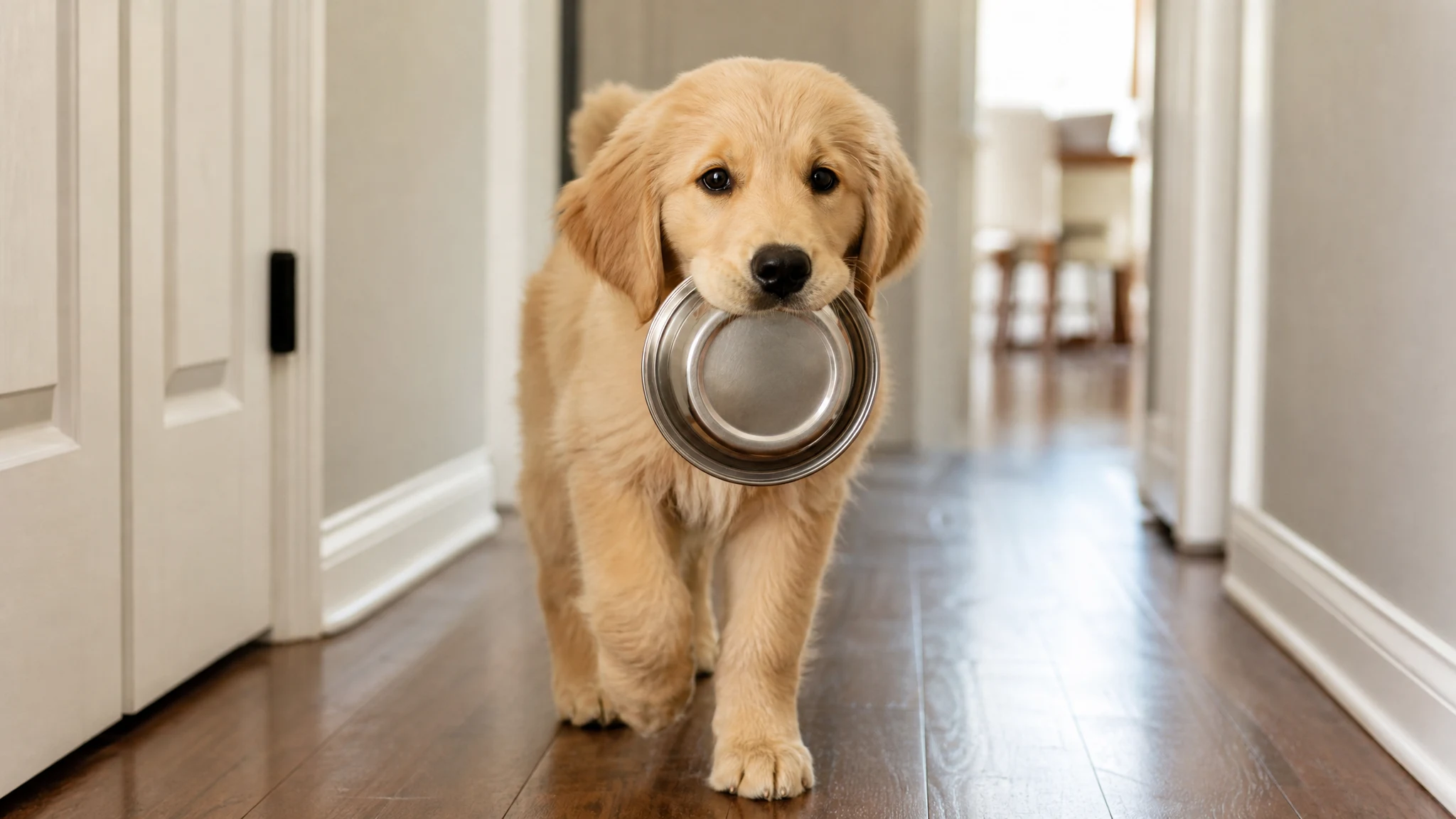
General nutrition information compiled from product labels and published sources, not veterinary advice. Your veterinarian is the right person to choose a diet for your dog, especially one with a health condition.
A golden retriever puppy feeding chart by age sounds simple. In practice, no single chart fits every puppy. Amounts depend on the food you pick, your puppy's current weight, and how fast they are growing.
This guide shows you how to build your own chart from the label of the food you choose. It then helps you check it against your puppy's body shape and your veterinarian's advice.
Why a generic chart falls short for Goldens
The Golden Retriever Club of America breed standard lists adult males at 65 to 75 pounds and females at 55 to 65 pounds. That puts the breed in the large category. The upper end for males is above the 70 pound cutoff used in AAFCO's large-size growth wording.
Cornell University College of Veterinary Medicine says hip dysplasia is genetic but can be modified by nutrition and growth rate. It says overfeeding and rapid growth can worsen it in predisposed dogs. Cornell advises a diet formulated for large breeds while puppies grow, and says not to supplement growing puppies with calcium or vitamin D.
No food prevents or treats a joint condition. The point is to avoid pushing growth too fast and to leave individual decisions to your veterinarian.
What you need
- The bag or can of your puppy's food, with its nutritional adequacy statement and feeding guide.
- A kitchen scale. Royal Canin's page notes that grams are the most accurate way to measure, and cups are only approximate.
- A way to weigh your puppy regularly, such as a pet scale, or your vet's clinic scale on a drop-in visit.
- A notebook or phone note to log weight, food amount and treats.
- Your veterinarian's phone number for the final check.
Step 1: Choose a food formulated for large-size growth
Look for the adequacy statement on the label. Under the AAFCO rule as adopted in Washington Administrative Code 16-252-044, foods claiming Growth or All Life Stages must end the statement with one of two phrases. One is "including growth of large size dogs (70 lb. or more as an adult)." The other is "except for growth of large size dogs (70 lb. or more as an adult)."
For a Golden, the "including" version is the one to look for. Cornell's panosteitis page, which lists Goldens among predisposed breeds, recommends a commercial large-breed puppy diet formulated to an AAFCO growth statement.
Our ranked guide to puppy foods for Golden Retriever puppies compares label data for several options. We compared labels only. We did not run feeding trials or taste tests.
Step 2: Find your puppy's current weight
Weigh your puppy and write the number down. Feeding guides on food packaging are built around body weight, so this is the starting input. Weigh again on a regular schedule. Your veterinarian can tell you how often fits your puppy.
Step 3: Estimate expected adult weight
The breed standard gives the range above, 55 to 75 pounds depending on sex. Your puppy's own parents and breeder records are a better guide than a general range. Ask the breeder what the parents weighed, and ask your veterinarian to estimate where your puppy is heading.
Some guides, such as Victor's, give their own amounts for dogs at different weights. Others, such as Royal Canin's Large Puppy page, show the chart as an image or direct you to a calculator. Always read the chart for the exact product in your bowl.
Step 4: Read the label's feeding guide
Find your puppy's current weight, and where the label gives it, age, in the brand's chart. The result is a starting point, not a prescription. Hill's, for example, tells owners to adjust amounts as necessary to maintain optimal weight and to ask a veterinarian if unsure.
Calories per cup differ a lot between foods. That is why you cannot copy a cup amount from one food to another.
| Food (brand page data) | Form | Calories listed |
|---|---|---|
| Royal Canin Large Puppy | Dry | 349 kcal ME per cup, as fed (calculated) |
| Royal Canin Golden Retriever Puppy | Dry | 339 kcal ME per cup, as fed (calculated) |
| Hill's Science Diet Puppy Large Breed Chicken & Brown Rice | Dry | 387 kcal per cup |
| Victor Classic Hi-Pro Plus Large Breed Puppy | Dry | 365 kcal per cup |
| Freshpet Multi-Protein Puppy Recipe with Green Beans & Carrots | Fresh | 241 kcal per cup |
| Freshpet Chicken, Egg, Salmon & Beef Puppy Recipe with Pumpkin, Cranberries & Carrots | Fresh | 259 kcal per cup |
A cup of one food can carry about 60 percent more calories than a cup of another. Swapping foods without rechecking the guide can change daily calories a lot.
Two details to check with the brand. The Royal Canin Golden Retriever Puppy page we opened did not show an AAFCO statement, so confirm its large-size growth wording with Royal Canin. Victor's page describes its food as formulated for All Life Stages and covers growth of large dogs. The full sentence was not captured, so read the bag.
Step 5: Build your chart by growth stage
Use the table below as a template. Fill the last column from your food's own guide and your vet's input.
| Stage | Food type | What sets the amount |
|---|---|---|
| Early growth, new puppy at home | Large-size growth formula | Current weight on the label chart, then your vet's check at the first visit |
| Fast growth months | Same food, no sudden changes | Re-weigh and re-read the chart as weight rises; confirm with your vet during growth spurts |
| Slowing growth, closer to adult size | Same food until your vet advises a change | Body shape and weight trend, not just the chart |
| About 12 to 18 months | Move to an adult food when your vet recommends | PetMD says to feed a large-breed puppy formula until 12 to 18 months, depending on the veterinarian's recommendation |
The label may also let you split the daily amount into more than one meal. Freshpet, for example, says its puppy recipes can be fed as one meal daily or divided into two. Ask your vet how many meals suit your puppy.
Step 6: Check body condition, then adjust
A chart gets you close. Your puppy's body tells you the rest. Ask your veterinarian to show you how to feel the ribs and check the waist from above. Cornell's advice is to avoid overfeeding fast-growing large-breed puppies and to keep a healthy weight through life.
If your puppy looks heavy or thin compared with what your vet showed you, do not guess. Call the clinic and adjust together.
Step 7: Change foods slowly and keep notes
If you switch brands, recheck calories per cup first. Ask your vet how to transition, and write down any digestive changes. Bring the log to checkups.
Tips
- Count treats and training rewards in the day's food. Reduce meals slightly if treats add up. Ask your vet how much.
- Weigh food in grams when you can, since cups vary.
- Use the same measuring tool every time.
- Keep one written chart and update it as weight changes.
- Tell your vet about any food changes before a growth spurt or a new health concern.
Common mistakes to avoid
- Feeding to a clean-bowl look. Puppies often eat what is offered. Follow the guide and your vet's advice, not appetite alone.
- Adding calcium or vitamin D. Cornell says not to supplement growing puppies with these. Check with your veterinarian before giving any supplement.
- Using a standard puppy food by default. Hill's own puppy original page has no large-breed calcium claim. For a Golden, a large-breed formula is the closer match.
- Copying amounts between foods. Calories per cup differ, as the table shows.
- Treating a grain-free label as a safety mark. FDA's DCM investigation page notes Golden Retrievers may be genetically predisposed to taurine deficiency linked to DCM. FDA also notes reporting bias for the breed. The last update on that page was December 23, 2022, and FDA said it did not plan further public updates without meaningful new science. Ask your vet about diet and heart health for your own dog.
- Switching to adult food on a calendar date. Follow your vet's call, not a fixed birthday.
What to expect
If you match the food to large-size growth, weigh regularly and adjust with your vet, you may see steady, gradual weight gain and a lean body shape. Many owners find a written chart makes meals easier to manage. No chart can promise a specific result, because every puppy grows differently.
Contact your veterinarian promptly if your puppy stops eating, loses weight, has ongoing stomach upset or seems sore when moving. Panosteitis, the growing-bone pain Cornell lists in predisposed breeds including Goldens, is one reason to ask rather than wait.
Before you finish
Confirm the final amounts with your veterinarian, especially during a growth spurt or any health concern. Check each brand's own page for the latest label data, since formulas and statements can change.
Sources
- Golden Retriever Club of America, Official Standard of the Golden Retriever
- Cornell University College of Veterinary Medicine, Canine hip dysplasia (CHD)
- Cornell University College of Veterinary Medicine, Panosteitis in dogs
- Washington Administrative Code 16-252-044, adopting the AAFCO model
- FDA CVM, Investigation into potential link between certain diets and canine DCM
- PetMD, Golden Retriever Dog Breed Health and Care
- Royal Canin, Golden Retriever Puppy dry dog food
- Royal Canin, Large Puppy dry dog food
- Hill's Pet Nutrition, Science Diet Puppy Large Breed
- Hill's Pet Nutrition, Science Diet Puppy Chicken & Brown Rice
- Victor, Classic Hi-Pro Plus Large Breed Puppy
- Freshpet, Multi-Protein Puppy Recipe
- Freshpet, Chicken, Egg, Salmon & Beef Puppy Recipe