Golden Retriever Feeding Chart: How Portions Change With Age
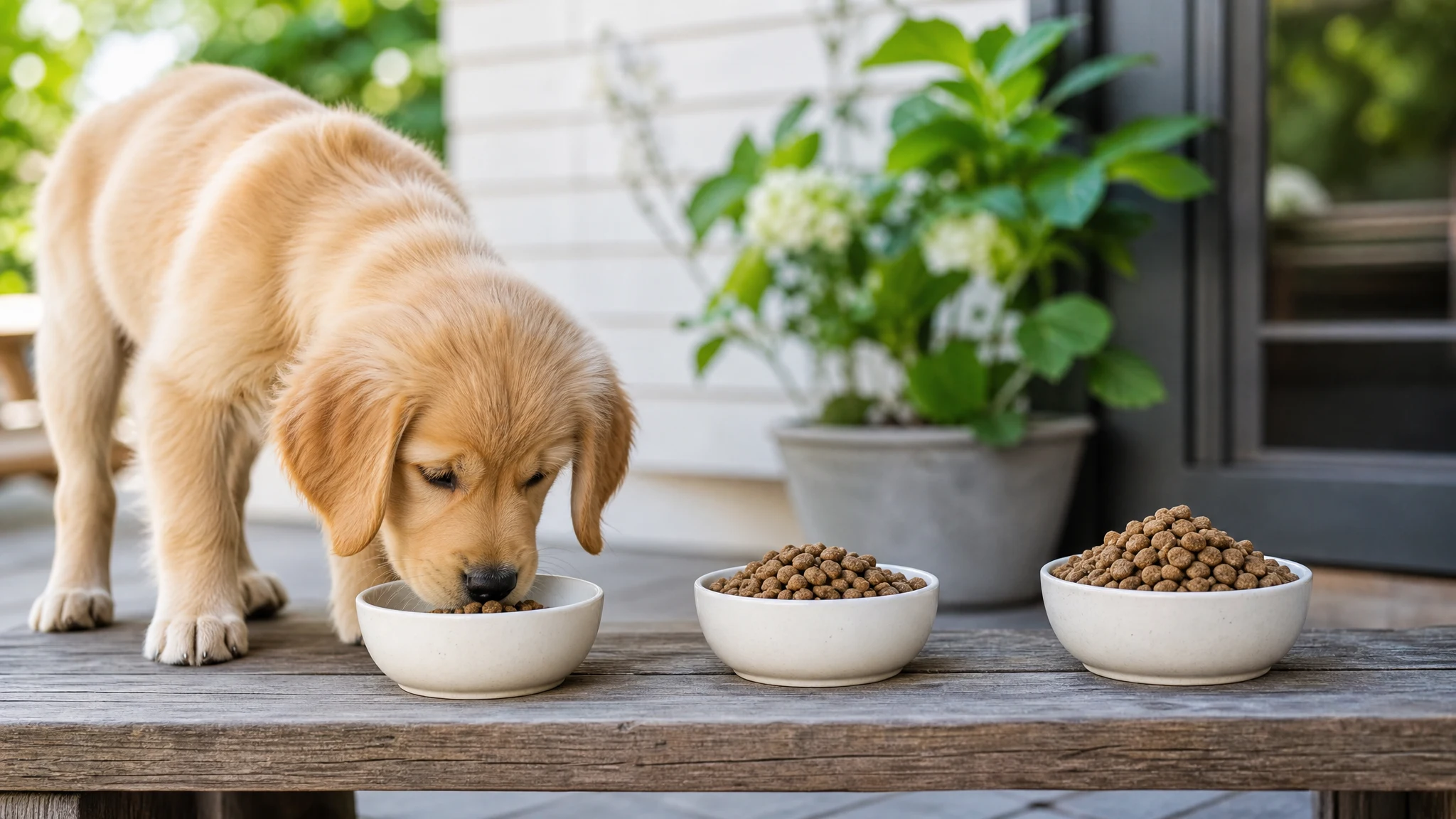
General nutrition information compiled from product labels and published sources, not veterinary advice. Your veterinarian is the right person to choose a diet for your dog, especially one with a health condition.
Most feeding charts are a table of ages and cups. The trouble is that a cup of one food can hold far more calories than a cup of another. A chart that ignores that can mislead you.
This guide shows you how to build your own golden retriever feeding chart from the label on your puppy's food. You will track it as your Golden Retriever grows and adjust it with your veterinarian. We did not run feeding trials or taste tests. Everything here comes from label data and published veterinary sources.
Why Golden Retriever puppies need a growth-aware chart
The Golden Retriever Club of America breed standard puts adult males at 65 to 75 pounds and females at 55 to 65 pounds. That makes Goldens a large breed. The AAFCO cutoff for "large size" dogs is 70 pounds or more as an adult, and a male at the top of the standard is above it.
Cornell University College of Veterinary Medicine says hip dysplasia is genetic but modified by nutrition and growth rate. It notes that overfeeding and rapid growth can worsen it in predisposed dogs. Cornell advises a diet formulated for large breeds while puppies grow, no calcium or vitamin D supplements for growing puppies, and avoiding overfeeding. Cornell also lists Golden Retrievers as predisposed to panosteitis, a growing-bone pain in young large-breed dogs. It recommends a commercial large-breed puppy diet formulated to an AAFCO growth statement.
None of this means a food prevents or treats a condition. It means portions and growth speed are worth watching. Your veterinarian decides what is right for your individual dog.
Materials you need
- The bag, can or package your puppy eats now, with the full label.
- A kitchen scale that measures grams. Royal Canin's Golden Retriever Puppy page says grams are the most accurate form of measurement and cups are only approximate.
- A standard dry measuring cup, if you feed by volume.
- A notebook or spreadsheet.
- A pet scale or a regular scale you can use while holding your puppy.
- Your veterinarian's contact details for check-ins.
Step 1: Confirm the food is made for large-breed growth
Find the nutritional adequacy statement on the label. Under the AAFCO rules adopted in Washington Administrative Code 16-252-044, a food claiming Growth or All Life Stages must end its statement one of two ways. It says either "including growth of large size dogs (70 lb. or more as an adult)" or "except for growth of large size dogs (70 lb. or more as an adult)." For a Golden Retriever puppy, look for "including."
Some examples from brand pages:
- Royal Canin's Large Puppy page says it is formulated for growth including growth of large size dogs.
- Freshpet's Chicken, Egg, Salmon & Beef Puppy recipe carries the same "including" language.
- Hill's Science Diet Puppy Chicken & Brown Rice, the standard puppy formula, shows no large-breed claim on its page. Hill's has a separate Puppy Large Breed formula, which is the closer fit for a Golden.
- Royal Canin's Golden Retriever Puppy page did not show an AAFCO statement when we looked. Check the bag, or ask the brand, before relying on it.
If you want help comparing options, see our ranked guide to puppy food for Golden Retrievers.
Step 2: Write down the calories per cup
Find the kcal per cup, or per kilogram, on the brand's page or bag. Brand pages list these figures:
- Royal Canin Large Puppy: 349 kcal per cup (calculated, as fed).
- Victor Classic Hi-Pro Plus Large Breed Puppy: 365 kcal per cup.
- Hill's Science Diet Puppy Large Breed: 387 kcal per cup.
- Freshpet Multi-Protein Puppy Recipe: 241 kcal per cup.
Compare Hill's at 387 with Freshpet at 241. A level cup of one delivers noticeably more energy than a cup of the other. That is why a chart copied from another owner's dog can be wrong for yours. Record your own food's number at the top of your chart.
Step 3: Find the label's feeding guide
Every brand organizes its guide differently. Some use current weight, some use expected adult weight, and some use age. Here is what the brands say:
- Hill's tells owners to adjust feeding amounts as necessary to maintain optimal weight, and to ask a veterinarian if unsure.
- Freshpet lets you select your dog's weight to see a daily amount, split into one or two meals.
- Royal Canin's Large Puppy page puts its chart in an image and tells you to calculate the ideal amount for your pet.
- Victor's page says to add half a cup for every 20 pounds over 100 pounds, which does not apply to a typical Golden.
Treat the label amount as a starting point, not a target. Copy it into your notebook for your puppy's current weight.
Step 4: Build your chart
Set up a table with these columns: date, age, weight, label amount (grams), what you actually fed, body condition and notes. Fill in a new row at every weigh-in.
The stages below show what changes over time and what to check. They do not give amounts, because the amounts belong to your food's label and your veterinarian.
| Stage | What to feed | What to check |
|---|---|---|
| Early growth | A large-breed puppy formula with an "including growth of large size dogs" statement | Label amount for current weight; ask your vet how many meals a day |
| Fast growth months | The same formula, with no calcium or vitamin D added | Weigh often; look for a visible waist and ribs you can feel |
| Slowing growth | The same formula until your vet advises a change | Re-read the label guide at each new weight; trim if weight gain outpaces the plan |
| Around 12 to 18 months | Switch to an adult food only when your vet says so | Plan a gradual change; recheck the new label's guide |
PetMD says to feed a large-breed puppy formula until 12 to 18 months, depending on the veterinarian's recommendation. That is a secondary source, so your vet's call comes first.
Step 5: Weigh, look and adjust
Weigh your puppy on a regular schedule and write it down. Then update the label amount for the new weight. Also run a quick body check. You should be able to feel the ribs under a light layer of padding, and see a waist from above.
If your puppy is gaining faster than your vet expects, ask about trimming portions rather than guessing. Cornell's warning about rapid growth is the reason to take this seriously. If your puppy seems thin or always hungry, raise that with your vet too, before you add food.
Step 6: Plan the switch to adult food
When your vet agrees your Golden is ready, move to the adult food gradually. Mix a little new food into the old and shift the balance over about a week or so, or on the schedule your vet suggests. Then rebuild your chart from the new label, because calories per cup will almost certainly differ.
Tips
- Count treats and training rewards in the daily total. Take them out of meals if you use a lot.
- Measure by weight in grams if you can.
- Change one thing at a time, so you can tell what caused any change in stool or appetite.
- Switch brands gradually, not overnight.
- Keep wet and fresh foods in the same chart, using each product's own calorie figure. Hill's lists its canned puppy foods per can, not per cup, and Freshpet lists some recipes per kilogram.
Common mistakes to avoid
- Copying a chart from a different food. The calories per cup differ between products.
- Using a standard puppy formula without a large-breed claim. Check the AAFCO statement.
- Adding calcium or other supplements. Cornell advises against calcium and vitamin D supplements for growing puppies. Ask your vet before adding anything.
- Feeding to the bottom of a bowl. Puppies often act hungry. Follow the plan and your puppy's body condition instead.
- Treating the label as fixed. The label is a starting point, and Hill's itself says to adjust to maintain optimal weight.
- Judging a food by one ingredient or a grain-free label. The FDA's investigation into diets and canine dilated cardiomyopathy (DCM) notes that Golden Retrievers may be genetically predisposed to taurine deficiency linked to DCM. It also notes reporting bias for the breed. The FDA's last update on that page was December 23, 2022. If you have questions about a diet and your dog's heart, ask your vet.
What to expect
If you weigh regularly and keep portions matched to the label and your vet's advice, your puppy may grow at a steadier pace. You may also find it easier to spot weight changes early. Results vary from dog to dog, and a chart cannot promise any outcome on joints, allergies or longevity.
Golden Retrievers are noted by PetMD as prone to atopic dermatitis, which is triggered by environmental allergens and is not shown on that page to be caused by diet. Skin or stool problems are a reason to call your vet, not to rewrite the chart on your own.
When to call your veterinarian
Confirm amounts with your vet at every puppy visit. Call sooner during a growth spurt, if your puppy stops eating, loses weight, limps or seems to be in pain, or has ongoing digestive trouble. Only a veterinarian can prescribe a special diet for a health condition.
Sources
- Golden Retriever Club of America, Official Standard of the Golden Retriever
- Cornell University College of Veterinary Medicine, Canine hip dysplasia (CHD)
- Cornell University College of Veterinary Medicine, Panosteitis in dogs
- Washington Administrative Code 16-252-044, via Cornell LII
- FDA CVM, Investigation into potential link between certain diets and canine DCM
- PetMD, Golden Retriever Dog Breed Health and Care
- Royal Canin, Large Puppy dry dog food
- Royal Canin, Golden Retriever Puppy dry dog food
- Hill's Pet Nutrition, Science Diet Puppy Large Breed
- Victor, Classic Hi-Pro Plus Large Breed Puppy
- Freshpet, Multi-Protein Puppy Recipe with Green Beans & Carrots