Best Treats for Golden Retriever Puppies for Training
General nutrition information compiled from product labels and published sources, not veterinary advice. Your veterinarian is the right person to choose a diet for your dog, especially one with a health condition.
Golden Retriever puppies are eager to please and love food, which makes treats a handy training tool. It also makes overfeeding easy. This guide shows how to choose and use the best treats for Golden Retriever puppies without throwing off a large-breed growth plan.
We did not taste-test or feed any treats. Nothing here ranks treat brands. The advice comes from veterinary school guidance on growing large-breed dogs and from the label data of puppy foods, which you can use as a model for what to look for.
Why treats need extra care for a Golden Retriever puppy
The Golden Retriever Club of America's breed standard lists adult males at 65 to 75 pounds and females at 55 to 65 pounds. That makes the breed large, and a large-breed puppy has to grow at a steady pace.
Cornell University College of Veterinary Medicine says canine hip dysplasia is genetic, but nutrition and growth rate can change how it shows up. Overfeeding and rapid growth can make it worse in dogs that are predisposed. Cornell advises against overfeeding fast-growing large-breed puppies and keeping a healthy weight through life.
Treats count as food. A pile of rewards on top of full meals is one of the easiest ways to overfeed. No treat prevents or treats a joint condition. Your veterinarian decides what is right for your individual puppy.
What you need
- A soft, tiny treat. Aim for pieces smaller than a pea, so a puppy can swallow them quickly and get back to work.
- A treat pouch or small container so rewards reach you in a second, not after a fumble.
- Part of your puppy's daily food. Kibble from the meal bowl is often the simplest reward.
- A kitchen scale or measuring cup. You need this to track what comes out of the daily ration.
- The calorie figure from your puppy food's label or brand page.
- A quiet room with few distractions for the first sessions.
Step-by-step: choosing and using treats
Step 1: Start with the main diet
Treats should not undo what the main food is doing. Cornell recommends a commercial large-breed puppy diet formulated to an AAFCO growth statement for breeds prone to panosteitis, a growing-bone pain condition. The Cornell page lists Golden Retrievers as a predisposed breed.
On the bag, look for the adequacy statement. Under AAFCO rules as adopted in Washington Administrative Code 16-252-044, a growth food must end with either "including growth of large size dogs (70 lb. or more as an adult)" or "except for growth of large size dogs." Pick the first kind. Our ranked list of puppy foods for Golden Retrievers compares label data for several options.
Step 2: Decide what share of the day's food goes to treats
Ask your veterinarian how much of your puppy's daily calories can come from treats. The answer depends on current weight, age and growth stage. Your puppy's weight will change fast, so ask again at each checkup, and especially during a growth spurt or if you notice a health concern.
Then use the food label as a starting point for the daily total. The brand's feeding guide is a starting point, not a prescription. Hill's, for example, says to adjust amounts to maintain optimal weight and to ask your veterinarian if you are unsure. Royal Canin's Large Puppy page invites you to calculate the amount for your puppy.
Step 3: Turn some of the meal into rewards
The simplest option is to set aside part of the measured daily kibble and use it in training. The puppy gets the same total food, and the label's calories stay in control.
Calorie density varies by food. The Hill's Science Diet Puppy Large Breed Chicken & Brown Rice Recipe lists 387 kcal per cup. Royal Canin Large Puppy lists 349 kcal per cup (calculated). Look up your own food's figure on the brand page. If you swap in a different treat, take its calories out of the day's meals.
Step 4: Pick a higher-value treat only for hard jobs
Plain kibble works for easy skills in a quiet room. For harder moments, such as recall outdoors, you may want something more exciting. Keep it soft and tiny.
Read the ingredient list and calorie count on any commercial treat. Pick one that is clear about what it contains. Skip treats that are high in calcium or marketed as a mineral boost. Cornell advises against supplementing growing puppies with calcium and vitamin D, so ask your vet before adding anything of that kind.
If your puppy has itchy skin or ear trouble, talk to your veterinarian before changing treats. PetMD notes that Goldens are prone to atopic dermatitis, which is triggered by environmental allergens. The page does not show that it is caused by diet.
Step 5: Reward the moment, in under two seconds
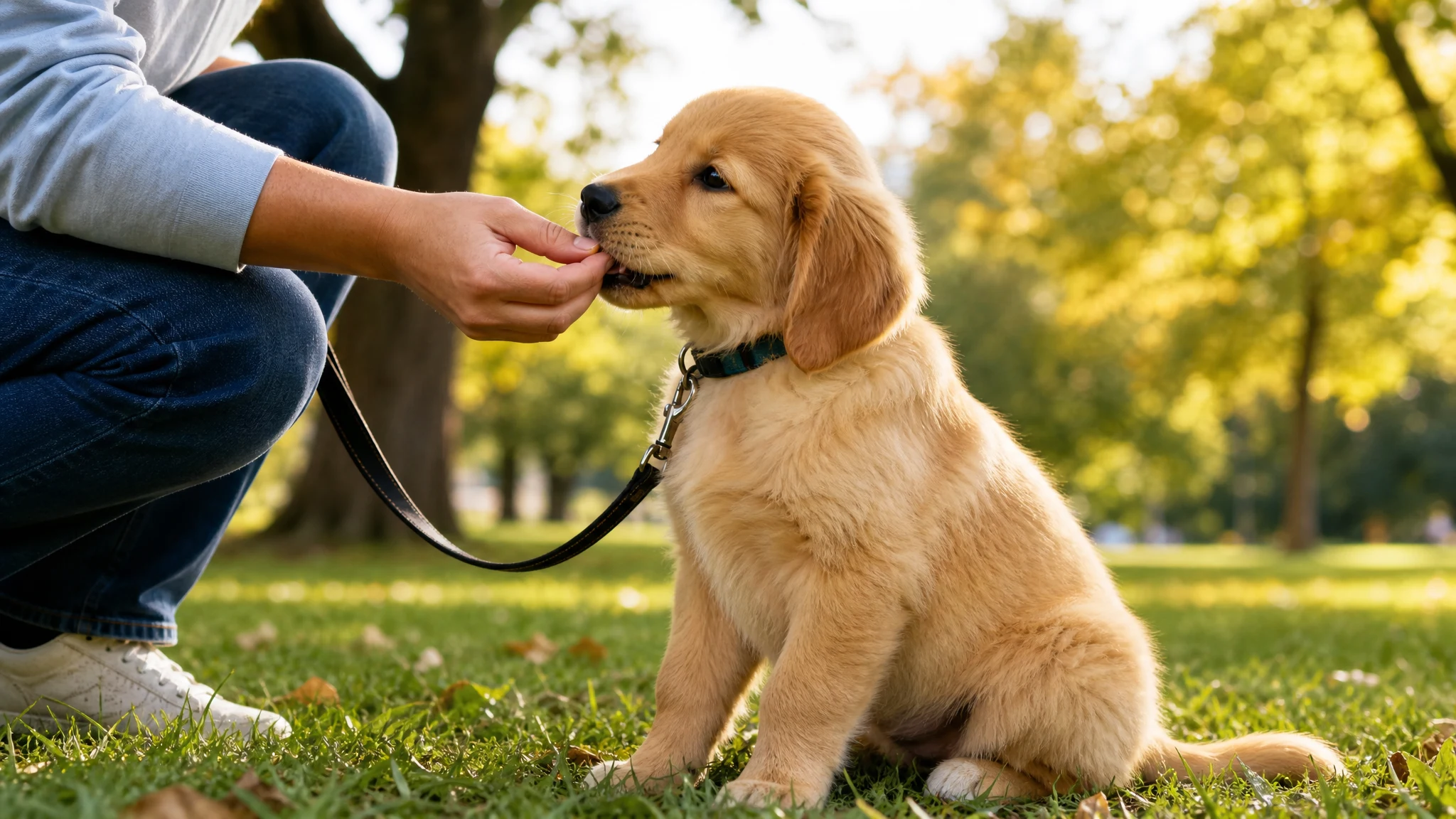
Mark the behavior with a word such as "yes," then deliver the treat right away. Start with a simple skill, such as sit, in a calm room. Deliver the treat low and close to the nose so the puppy doesn't jump.
Reward-based training is the approach the American Veterinary Society of Animal Behavior supports. Skip leash jerks, harsh corrections and punishment. They add fear without teaching what to do.
Step 6: Keep sessions short and stop early
Practice for a few minutes, a few times a day. Stop while the puppy is still interested. Use the same short session length even when progress is fast, because tired puppies make mistakes and eat more treats.
Step 7: Fade the treats gradually
Once a skill is reliable, reward some repetitions and not others. Add praise, a toss of a toy or a quick game as rewards. This keeps the calorie count down and builds a dog that works for more than food.
Treat ideas that fit most Golden Retriever puppy plans
- Pieces of the puppy's own kibble. This is predictable and simple to count.
- Soft puppy treats broken into tiny bits. Check the label and subtract the calories from meals.
- Non-food rewards. Praise, a short game of tug or a sniff walk can pay well for many Goldens.
- Foods your vet has approved. Ask which human foods are safe and which to avoid. Check each one before you use it.
We do not name particular treat brands here. We have no label data to compare, and a treat's value depends on your puppy's diet and your veterinarian's advice. If you are considering a specific treat, check the brand's own website for the ingredients and calories.
Common mistakes to avoid
- Not counting treats. Many small rewards add up quickly in a puppy that weighs only a few pounds.
- Using big pieces. Large treats slow training and add calories.
- Adding calcium or vitamin supplements. Cornell advises against calcium and vitamin D for growing puppies. Do not add them on your own.
- Feeding the same total plus treats. If treats are going up, meals should come down.
- Treating a body-condition problem by guesswork. If your puppy looks heavy or thin, ask your veterinarian to score it.
- Using treats as a bribe. Show the treat after the behavior, not before.
- Switching foods suddenly. New foods are best introduced under your vet's guidance.
Expected results
With short, regular sessions and well-timed rewards, many puppies start to respond reliably to simple cues over a few weeks. Results vary by puppy, by age and by how consistent everyone in the house is. Treats are not a shortcut. Timing and repetition do most of the work.
Keeping treats inside the daily ration may help support steady growth, and your vet can confirm what a healthy pace looks like for your puppy. Do not expect treats to protect against any health condition.
How long to keep using puppy rules
PetMD says to feed a large-breed puppy formula until 12 to 18 months of age, depending on your veterinarian's recommendation. Keep counting treats through that period, then ask your vet how to adjust when your dog moves to adult food.
A Golden's growth period is also a good time to build habits that last. A dog that learns to work for small rewards, and a family that counts them, is better set up for a healthy weight in adulthood.
Sources
- Cornell University College of Veterinary Medicine, Canine hip dysplasia (CHD)
- Cornell University College of Veterinary Medicine, Panosteitis in dogs
- Golden Retriever Club of America, Official Standard of the Golden Retriever
- Washington Administrative Code 16-252-044, via Cornell LII
- PetMD, Golden Retriever Dog Breed Health and Care
- Hill's Pet Nutrition, Science Diet Puppy Large Breed Chicken & Brown Rice Recipe
- Royal Canin US, Large Puppy dry dog food