Royal Canin Golden Retriever Puppy Food vs Other Growth Formulas
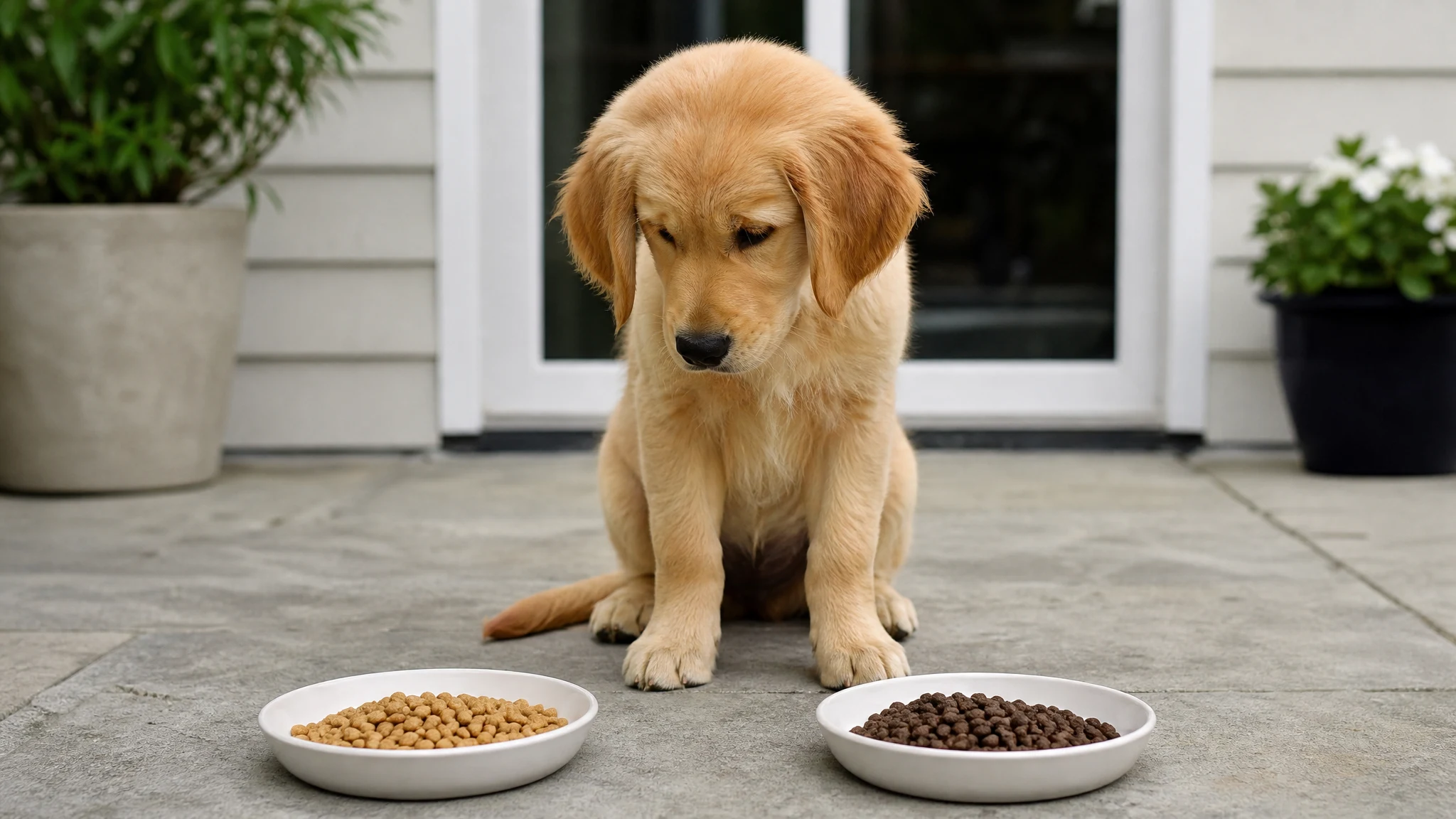
General nutrition information compiled from product labels and published sources, not veterinary advice. Your veterinarian is the right person to choose a diet for your dog, especially one with a health condition.
This is a royal canin golden retriever puppy food review built around one question: how do you compare a breed-labeled puppy food with other growth formulas without trusting the front of the bag? The answer is a short, repeatable label check. This guide walks through it step by step.
One note on method. We compared label data published on the brands' own pages. We did not run feeding trials or taste tests, and nothing here says one food is right for your dog. A veterinarian decides that.
Why Golden Retriever puppies need a careful label check
The Golden Retriever Club of America's breed standard lists adult males at 65 to 75 pounds and females at 55 to 65 pounds. The AAFCO large-size cutoff is 70 pounds or more as an adult, so many Goldens grow up in or near the large-dog range.
Cornell University's College of Veterinary Medicine says growing large-breed puppies should eat a diet formulated for large breeds. It also advises against overfeeding and rapid growth, and against adding calcium and vitamin D to a growing puppy's diet. For panosteitis, a growing-bone pain condition that lists Golden Retrievers as a predisposed breed, Cornell recommends a commercial large-breed puppy diet formulated to an AAFCO growth statement.
That is why the first thing to read is the nutritional adequacy statement, not the breed name on the front.
Materials you need
- The bag, can or package of each food you are weighing, or its page on the brand's own site.
- A notepad or spreadsheet with one row per food.
- Your puppy's current weight and age, from your veterinarian's last visit.
- A question list for your veterinarian.
Step-by-step: how to compare the foods
Step 1: Find the AAFCO statement and read the ending
Under Washington Administrative Code 16-252-044, which adopts the AAFCO model, a food claiming Growth or All Life Stages must end its statement with one of two phrases. One is "including growth of large size dogs (70 lb. or more as an adult)." The other is "except for growth of large size dogs (70 lb. or more as an adult)."
For a Golden Retriever puppy, the "including" version is the one to look for. An "except" ending means the food was not formulated to the large-size growth levels.
On the Royal Canin Golden Retriever Puppy page, the AAFCO statement was not visible when we read it. The page showed only a footnote that a nutrient is not recognized as essential by the AAFCO Dog Food Nutrient Profiles. Check the bag itself or ask Royal Canin for the full statement before you decide.
Step 2: Compare protein and fat the same way for every food
Dry foods publish minimums on the label. Some brands publish dry matter averages instead, and those numbers are not interchangeable. Write down which kind each number is.
Fresh and canned foods contain a lot of water. Their percentages look low next to kibble, but the two are not comparable until you convert to dry matter.
Step 3: Note calories per cup
Calories matter because Cornell links overfeeding and fast growth to hip dysplasia risk in predisposed dogs. Hip dysplasia is genetic, and nutrition and growth rate modify it. A food with more calories per cup needs a smaller portion.
Step 4: Check kibble size and ingredient order
Ingredients are listed by weight before cooking, so the first five tell you the main building blocks. They do not tell you quality on their own. Note kibble size where the brand states it, and mark "not stated" where it does not.
Step 5: Look for calcium, and do not guess
Calcium matters in large-breed growth, but several of these pages do not publish a number. If a brand does not list it, write "ask the brand" in your notes. Do not fill the gap from memory.
Step 6: Take the table to your veterinarian
Bring your notes to a visit. Your veterinarian can weigh the label data against your puppy's body condition and growth.
What the label data shows
These figures come from each brand's own product page. "Not stated" means the page did not give a value.
| Food | Growth wording | Protein / fat / fiber | Calories | Kibble size |
|---|---|---|---|---|
| Royal Canin Golden Retriever Puppy (dry) | Not seen on the page | 27% min / 14% min / 5.4% max | 339 kcal per cup | Breed-shaped, no dimensions |
| Royal Canin Large Puppy (dry) | Growth, including large size dogs | 28% min / 14% min / 3.7% max | 349 kcal per cup | Not stated |
| Hill's Science Diet Puppy Large Breed Chicken & Brown Rice (dry) | AAFCO feeding tests, growing puppies | Dry matter averages: 26.7% / 15.4% / 2.8% | 387 kcal per cup | Not stated |
| Victor Classic Hi-Pro Plus Large Breed Puppy (dry) | All life stages, also covers growth of large dogs | 30% min / 14% min / 6.0% max | 365 kcal per cup | "Appropriate" for large breeds, no dimensions |
| Freshpet Chicken, Egg, Salmon & Beef Puppy Recipe (fresh) | Growth, including large size dogs | 18% min / 12% min / 2% max (as fed) | 259 kcal per cup | Not applicable |
Brand pages: Royal Canin Golden Retriever Puppy, Royal Canin Large Puppy, Hill's Puppy Large Breed, Victor Hi-Pro Plus Large Breed Puppy and Freshpet Puppy Recipe.
Reading the comparison
The Royal Canin Golden Retriever Puppy food has the lowest calories per cup of the dry foods here, at 339. Its first five ingredients are chicken by-product meal, corn, chicken fat, wheat and brewers rice. It is not grain-free. The breed-shaped kibble is the main breed-specific feature on the page, and no dimensions are given.
The Royal Canin Large Puppy formula has a clear "including growth of large size dogs" statement on its page. If the AAFCO wording on the Golden Retriever bag cannot be confirmed, this is the closest Royal Canin option with a published large-size claim.
The Hill's large breed recipe leads with chicken, brown rice, whole grain oats, chicken meal and cracked pearled barley. Its page says AAFCO feeding tests substantiate complete and balanced nutrition for growing puppies. The wording we captured does not include a large-size growth phrase, so read the bag for that ending. It also has the most calories per cup in the table at 387, so portions need to be watched.
Victor lists the highest protein minimum at 30%, and it is labeled for all life stages, with the page also covering large-dog growth. Its fiber maximum of 6.0% is the highest in the table.
The Freshpet recipe states the "including growth of large size dogs" wording clearly. Its percentages are as fed and include water, so do not set them against kibble numbers directly.
Our ranked guide to puppy food for Golden Retriever puppies applies the same label method across more products.
Tips
- Treat label feeding charts as starting points. Royal Canin says its guide is only a guide, and Hill's says to adjust amounts to maintain optimal weight and to ask your veterinarian if unsure.
- Weigh portions in grams when a brand offers them. Royal Canin notes grams are more accurate than cups.
- Change foods gradually, and ask your veterinarian how to schedule it for your puppy.
- Do not add calcium or vitamin D to a growing puppy's food. Cornell advises against it.
- Ask your veterinarian when to move to an adult food. PetMD, a secondary source, says large-breed puppy formulas are typically fed until 12 to 18 months, depending on the veterinarian's recommendation.
Common mistakes to avoid
- Trusting the breed name. A breed on the front is marketing until the AAFCO ending confirms large-size growth.
- Comparing mixed numbers. Minimums, dry matter averages and as-fed fresh food figures are different measurements.
- Judging by price or calories alone. Calories per cup only matter alongside the portion you actually feed.
- Feeding to a fat puppy. Cornell says to avoid overfeeding fast-growing large-breed puppies.
- Choosing a food for a disease-related purpose. No label here claims that, and none should be read that way.
A note on DCM and taurine
The FDA's investigation into diets and canine dilated cardiomyopathy (DCM) notes that Golden Retrievers may be genetically predisposed to taurine deficiency linked to DCM. The FDA also notes reporting bias for the breed. Its latest update on that page is dated December 23, 2022, and it said it did not plan further public updates without meaningful new science. Check the page for anything newer, and ask your veterinarian about your puppy's diet.
Expected results
A careful label comparison may help you narrow the field to a few foods that state large-size growth wording and fit your budget and your puppy's portions. It may also show you which questions to bring to a veterinarian or the brand.
It cannot tell you how your puppy will do on a food. Appetite, stool quality, body condition and growth are things your veterinarian can track. Results vary from dog to dog.
Sources
- Golden Retriever Club of America, Official Standard of the Golden Retriever
- Washington Administrative Code 16-252-044, via Cornell LII
- Cornell University College of Veterinary Medicine, Canine hip dysplasia
- Cornell University College of Veterinary Medicine, Panosteitis in dogs
- FDA CVM, Investigation into potential link between certain diets and canine DCM
- PetMD, Golden Retriever Dog Breed Health and Care
- Royal Canin US, Golden Retriever Puppy
- Hill's Pet Nutrition, Science Diet Puppy Large Breed
- Victor Super Premium Pet Food, Hi-Pro Plus Large Breed Puppy
- Freshpet, Puppy Recipe