Golden Retriever Puppy Kibble: Small Bites vs Regular
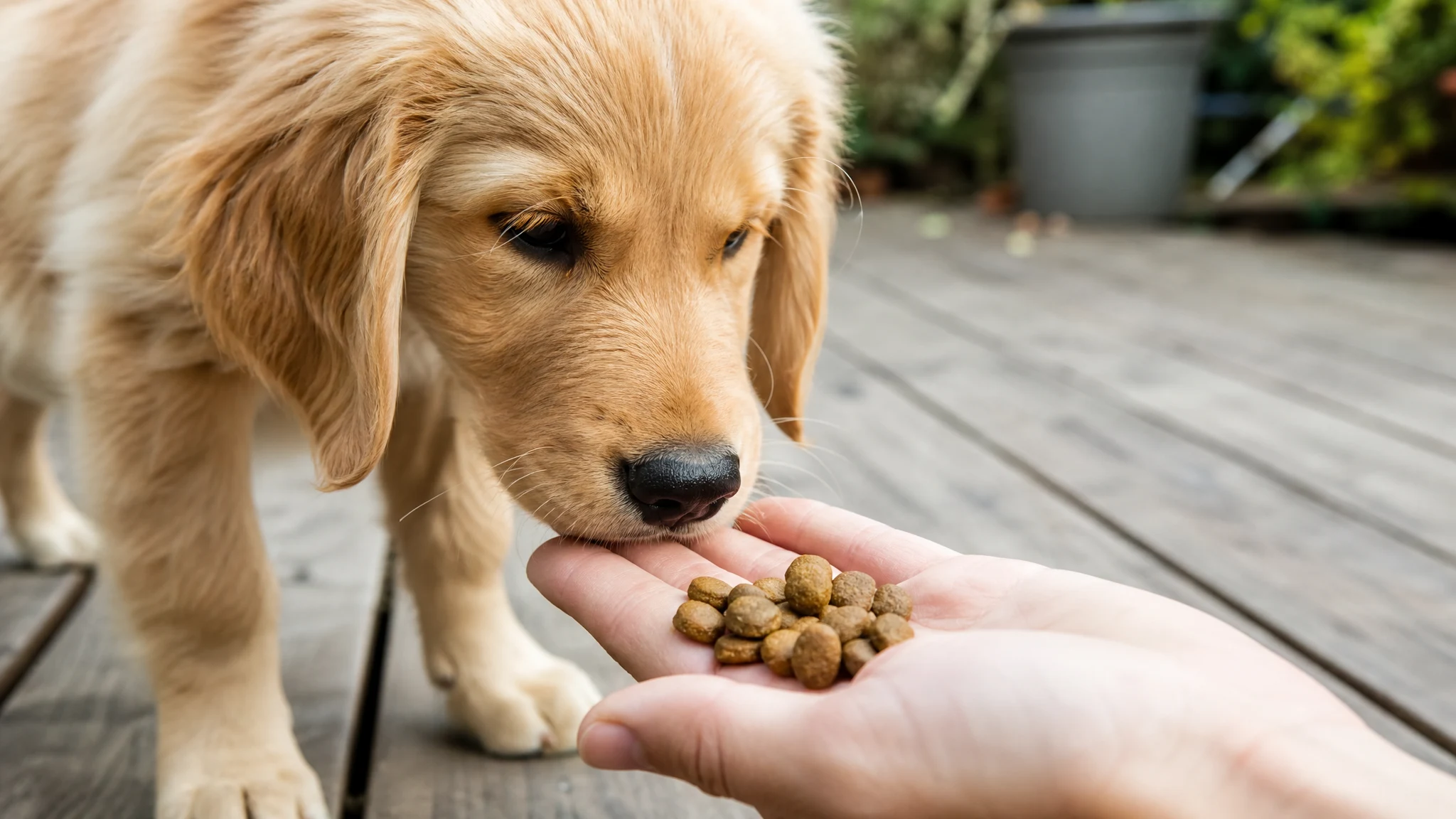
General nutrition information compiled from product labels and published sources, not veterinary advice. Your veterinarian is the right person to choose a diet for your dog, especially one with a health condition.
Walk down a pet food aisle and you will see bags promising "small bites" for puppies and "regular" kibble for bigger dogs. A Golden Retriever puppy is small now but will be a large dog. So which size fits?
This guide shows you how to check golden retriever kibble labels, judge bite size at home, and avoid the usual mistakes. It compares label data only. We did not run feeding trials or taste tests, and we have not fed any of these foods to dogs.
What the label data can and cannot tell you about kibble size
Kibble size is the least documented part of most dog food labels. Of the dry puppy foods we compared, none gives a measurement in millimeters or inches on its brand page.
- Royal Canin describes its Golden Retriever Puppy dry food as a breed-shaped kibble, with no dimensions stated.
- Victor says its Classic Hi-Pro Plus Large Breed Puppy has an "appropriate kibble size" for large breeds, with no dimensions.
- Royal Canin Large Puppy and both Hill's Science Diet dry puppy foods do not state a kibble size on their pages.
So the honest answer is that the label alone will not settle small versus regular. You have to check the real kibble against your puppy. The steps below show how. If a brand page is silent, ask the brand directly.
Materials you will need
- The bag or the brand's product page for each food you are considering
- A kitchen scale that reads in grams
- A measuring cup (for comparing against the label's cup guide)
- A small sample of each kibble, if the brand or your veterinary clinic offers one
- A notebook or phone note for your puppy's weight and meals
- Your veterinarian's contact details for the final check
Step 1: Start with the growth statement, not the bite size
Bite size is a secondary question. First confirm the food is built for a growing large-breed dog.
The Golden Retriever Club of America's breed standard lists adult males at 65 to 75 pounds and females at 55 to 65 pounds. That puts the breed in the large category. The AAFCO rules, as adopted in Washington Administrative Code 16-252-044, require foods claiming growth or all life stages to end the adequacy statement in one of two ways. Look for either "including growth of large size dogs (70 lb. or more as an adult)" or "except for growth of large size dogs (70 lb. or more as an adult)."
Cornell University College of Veterinary Medicine recommends a commercial large-breed puppy diet formulated to an AAFCO growth statement for dogs prone to panosteitis, a growing-bone condition. It lists Golden Retrievers as a predisposed breed.
Write down which statement each food carries. If the statement is missing from the brand page, as it is on the Royal Canin Golden Retriever Puppy page we opened, check the bag or ask Royal Canin.
Step 2: Compare the numbers on the page
Here is what the brand pages publish for the dry puppy foods we compared. Hill's lists dry matter averages, not minimums, so those figures are not directly comparable with the as-fed minimums from the others.
| Food | Growth statement | Protein | Fat | kcal per cup | Kibble size |
|---|---|---|---|---|---|
| Royal Canin Golden Retriever Puppy | Not shown on page | 27% min | 14% min | 339 (calculated) | Breed-shaped, no dimensions |
| Royal Canin Large Puppy | Growth, including large size dogs | 28% min | 14% min | 349 (calculated) | Not stated |
| Hill's Science Diet Puppy Large Breed Chicken & Brown Rice | AAFCO feeding tests, growing puppies | 26.7% dry matter avg | 15.4% dry matter avg | 387 | Not stated |
| Hill's Science Diet Puppy Chicken & Brown Rice | AAFCO feeding tests, growing puppies | 28.1% dry matter avg | 19.1% dry matter avg | 390 | Not stated |
| Victor Classic Hi-Pro Plus Large Breed Puppy | All life stages, page also covers growth of large dogs | 30% min | 14% min | 365 | "Appropriate" for large breeds, no dimensions |
Calcium levels are not published on the pages we reviewed, so check the bag or ask the brand. The standard Hill's Puppy page carries no large-breed claim, and the large-breed version is the closer match for a Golden Retriever. Our ranked guide to puppy food for Golden Retrievers goes deeper on the full label comparison.
Step 3: Judge the bite at home
Because brands rarely publish dimensions, a simple home check helps.
- Pour a small portion into a bowl. Look at one piece next to your puppy's mouth. A piece that fits comfortably on the tongue is a reasonable starting point.
- Watch the first few meals. Note whether your puppy picks pieces up easily, chews, or gulps them whole.
- Compare two foods side by side. If you have samples, set a few pieces of each on a plate. Differences in size and shape are often easy to see.
- Weigh a cup. Cup weight varies by kibble density, so grams are a better guide than cups. Royal Canin itself says grams are the most accurate form of measurement on its Golden Retriever Puppy page.
Step 4: Set the amount as a starting point
Feeding charts are starting points. They are not targets. Hill's tells owners to adjust amounts as needed to maintain optimal weight and to ask a veterinarian if unsure. Victor's page adds a note for very large dogs, increasing intake by half a cup for every 20 pounds over 100 pounds, which does not apply to a growing puppy.
Cornell's veterinary college notes that overfeeding and rapid growth can worsen hip dysplasia in predisposed dogs, a condition that is genetic but modified by nutrition and growth rate. It advises avoiding overfeeding fast-growing large-breed puppies. It also advises against giving growing puppies calcium and vitamin D supplements. Your veterinarian decides what is right for an individual dog.
Step 5: Track and recheck
- Weigh your puppy on a regular schedule and write the number down.
- Note stool quality, appetite and how quickly meals are finished.
- Bring the notes to each veterinary visit and ask whether the weight curve looks right.
- Change foods gradually if your veterinarian recommends a switch, mixing the new food in over several days.
Tips
- Choose the growth statement first, then bite size. A small piece in a food without a suitable statement is not a good trade.
- Use a slow-feeder bowl or scatter a few pieces on a mat if your puppy gulps. Gulping is about eating speed, and a different shape may not fix it.
- Use part of the daily kibble as training rewards so treats do not add extra calories.
- Ask the brand for kibble dimensions by email or phone. A direct answer beats a guess.
- Keep the old bag's batch information handy if you switch, in case your veterinarian asks.
Common mistakes to avoid
- Assuming small bites are always better. Nothing on the pages we reviewed shows that smaller pieces suit Golden Retriever puppies better. Treat bite size as a fit question for your own puppy.
- Buying a breed-named bag and skipping the label. A Golden Retriever name on the front does not replace the growth statement.
- Comparing guaranteed analysis across different bases. As-fed minimums and dry matter averages are not the same measure.
- Feeding by the cup without checking weight. Cups differ from bag to bag.
- Adding calcium or vitamin supplements. Cornell advises against supplementing growing puppies with calcium and vitamin D.
- Treating a food as a fix for a health problem. Diet can be part of the picture for conditions such as hip dysplasia, but no food on this page is claimed to prevent or treat anything.
What to expect
If the food has a suitable growth statement and the pieces suit your puppy, you may notice steady eating, easy chewing and a body shape your veterinarian considers healthy. Results vary from dog to dog. Some puppies take a week or two to settle on a new food, and some need a different size or shape.
Large-breed puppy food is typically fed until about 12 to 18 months, according to PetMD, depending on your veterinarian's recommendation. Ask your veterinarian when to move to an adult formula.
One more note. The FDA has an ongoing investigation into a possible link between certain diets and canine dilated cardiomyopathy (DCM). It notes that Golden Retrievers may be genetically predisposed to taurine deficiency linked to DCM, and that reporting bias for the breed is possible. The latest update on the FDA page we reviewed is dated December 23, 2022. Raise any diet questions with your veterinarian.
Sources
- Golden Retriever Club of America, Official Standard of the Golden Retriever
- Washington Administrative Code 16-252-044, via Cornell LII
- Cornell University College of Veterinary Medicine, Canine hip dysplasia
- Cornell University College of Veterinary Medicine, Panosteitis in dogs
- FDA CVM, Investigation into potential link between certain diets and canine DCM
- PetMD, Golden Retriever Dog Breed Health and Care
- Royal Canin, Golden Retriever Puppy product page
- Royal Canin, Large Puppy product page
- Hill's Pet Nutrition, Science Diet Puppy Large Breed
- Hill's Pet Nutrition, Science Diet Puppy
- Victor, Classic Hi-Pro Plus Large Breed Puppy