Dry, Wet and Fresh Puppy Food for Golden Retriever Puppies: What the Labels Say
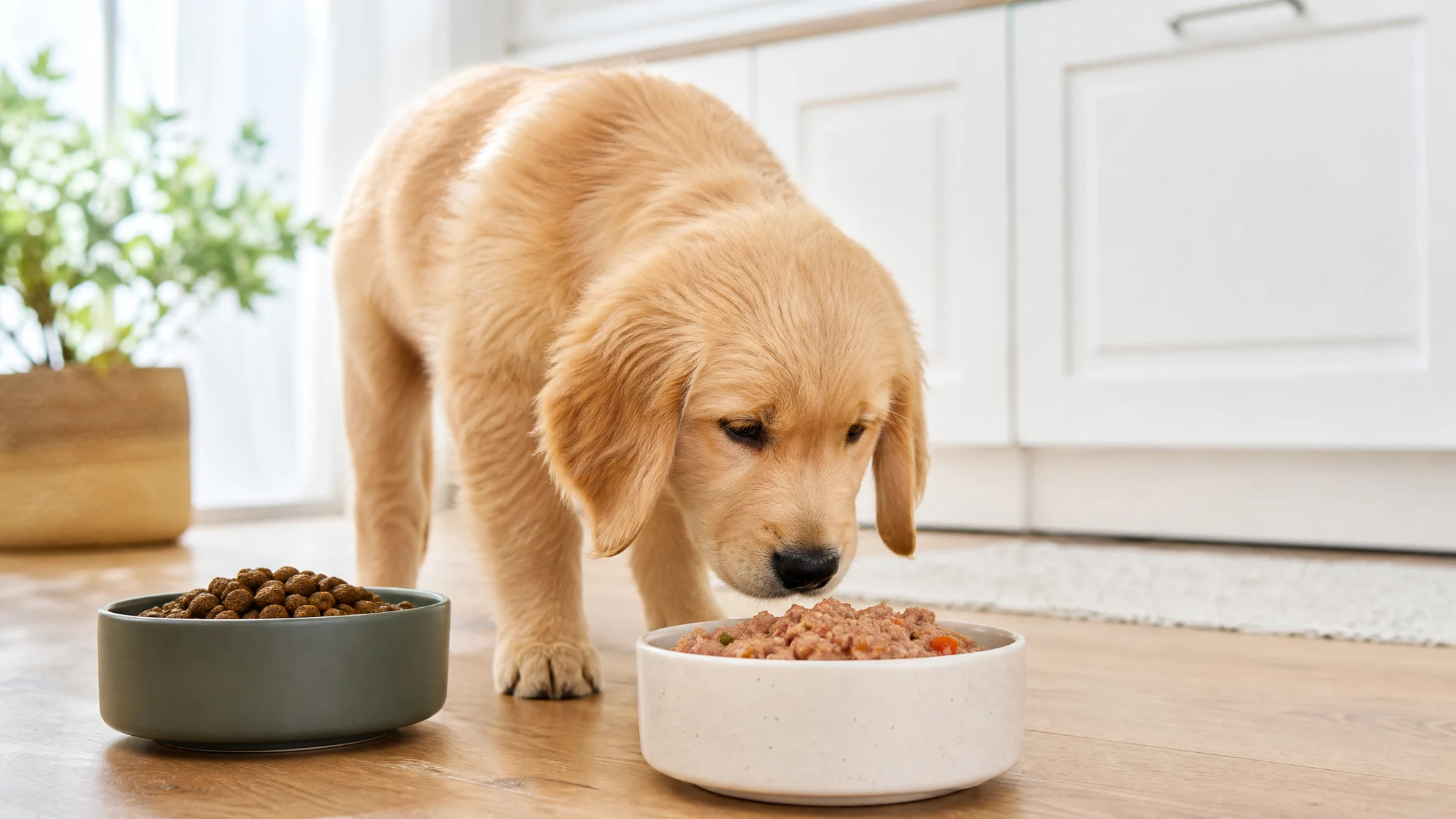
General nutrition information compiled from product labels and published sources, not veterinary advice. Your veterinarian is the right person to choose a diet for your dog, especially one with a health condition.
Dry vs wet puppy food is the first fork most Golden Retriever owners hit, and fresh food now makes it a three-way choice. Each form comes with its own marketing. This page sets the marketing aside and looks at what the labels and product pages actually state.
The method is simple. We compared label data: the nutritional adequacy statement, the first ingredients, the calories and the feeding notes. We did not run feeding trials or taste tests, so nothing here says which food a puppy likes best or which one gives better results.
Start with the puppy, not the form
The Golden Retriever Club of America breed standard lists adult males at 65 to 75 pounds and females at 55 to 65 pounds. That puts the breed in large-dog territory. A Golden puppy will grow a lot in its first year.
Cornell University College of Veterinary Medicine says canine hip dysplasia is genetic but modified by nutrition and growth rate. It advises feeding a diet formulated for large breeds, avoiding overfeeding and rapid growth, and not adding calcium or vitamin D supplements to a growing puppy. Cornell's page on panosteitis, a growing-bone pain in young large-breed dogs, lists Golden Retrievers as predisposed. It recommends a commercial large-breed puppy diet formulated to an AAFCO growth statement.
None of this says a food prevents or treats a condition. It means one label line matters more than the form of the food: the adequacy statement. Under the AAFCO model rules, as adopted in Washington Administrative Code 16-252-044, a food claiming Growth or All Life Stages must end its statement with either "including growth of large size dogs (70 lb. or more as an adult)" or "except for growth of large size dogs (70 lb. or more as an adult)." For a Golden Retriever puppy, look for the "including" version, whichever form you pick.
PetMD suggests feeding a large-breed puppy formula until 12 to 18 months of age, depending on the veterinarian's recommendation. Your veterinarian decides when your own dog switches.
The products compared
Only foods with label data we could read are included. Each is described only by what the brand states.
Dry
- Royal Canin Golden Retriever Puppy: 339 kcal per cup as fed (calculated). Minimum protein 27%, minimum fat 14%, maximum fiber 5.4%. First ingredients: chicken by-product meal, corn, chicken fat, wheat, brewers rice. The opened page did not show an AAFCO adequacy statement.
- Royal Canin Large Puppy: 349 kcal per cup. Statement covers growth including large size dogs. Minimum protein 28%, minimum fat 14%, maximum fiber 3.7%.
- Hill's Science Diet Puppy Large Breed Chicken & Brown Rice: 387 kcal per cup. Hill's states that AAFCO-procedure feeding tests substantiate complete and balanced nutrition for growing puppies. The page gives dry matter averages (protein 26.7%, fat 15.4%, crude fiber 2.8%) rather than minimums.
- Victor Classic Hi-Pro Plus Large Breed Puppy: 365 kcal per cup. Labeled for all life stages and also covers growth of large dogs. Minimum protein 30%, minimum fat 14%, maximum fiber 6%.
Wet
- Hill's Science Diet Puppy Chicken & Barley Entree: 495 kcal per 13 oz can (1339 kcal/kg). Water is the first ingredient.
- Hill's Science Diet Puppy Savory Stew with Chicken & Vegetables: 327 kcal per can (901 kcal/kg).
Both Hill's cans are standard puppy foods, not large-breed specific. The pages we reviewed make no large-size claim.
Fresh
- Freshpet Puppy: Chicken, Egg, Salmon & Beef with Pumpkin, Cranberries & Carrots: 259 kcal per cup (2,086 kcal/kg). Statement covers growth including large size dogs.
- Freshpet Multi-Protein Puppy with Green Beans & Carrots: 241 kcal per cup (2,049 kcal/kg). Same large-size growth wording.
- Freshpet Vital Puppy: Chicken, Beef & Salmon with Sweet Potatoes & Spinach: 1420 kcal/kg and 322 kcal per half pound. Grain-free. Statement covers all life stages including growth of large size dogs.
- JustFoodForDogs Chicken & White Rice: 1530 kcal ME/kg and 774 kcal ME per 18 oz. The page says all life stages including growth for large dogs of 70+ lb as adults. The exact wording was not captured, so read it on the label.
- JustFoodForDogs Fish & Sweet Potato: 922 kcal ME/kg and 468 kcal ME per 18 oz. The statement we have says all life stages, with no large-size wording.
Side-by-side comparison
| Attribute | Dry | Wet (canned) | Fresh |
|---|---|---|---|
| Moisture | Low. Compared on label minimums or dry matter averages. | High. Water is the first ingredient in both Hill's cans. | High. Broth or fresh meats lead several ingredient lists. Exact moisture varies by recipe. |
| Calories per kg (as fed) | 3560 to 3721 in the dry foods above | 901 to 1339 | 922 to 2086 |
| Calories per cup | 339 to 390 | Not given per cup; 327 to 495 per can | 241 to 259 where stated per cup |
| Large-size growth wording found | Royal Canin Large Puppy, Hill's Large Breed (feeding-test claim), Victor | Not found on the Hill's cans | Freshpet recipes; JustFoodForDogs Chicken & Rice (check label) |
| Kibble size | Royal Canin Golden Retriever Puppy is breed-shaped. No dimensions stated by any brand. | Not applicable | Not applicable (rolls and cooked recipes) |
| Published price | Check the brand | Check the brand | Check the brand |
One caution about the table. Protein and fat percentages on a wet or fresh label are "as fed," including the water. They look small next to dry food, but they are not comparable until converted to dry matter. For that reason the table leaves protein and fat out, and this page does not rank foods on those numbers.
Moisture and calorie density
Calorie density is the most useful difference between the forms for a Golden puppy. The dry foods above sit at roughly 3560 to 3721 kcal/kg. The wet and fresh foods land between 901 and 2086 kcal/kg. The same weight of food delivers very different energy.
This matters because of Cornell's advice to avoid overfeeding a fast-growing large-breed puppy. Moving from dry to fresh by volume, or by feel, without checking the feeding guide can put a puppy well over or under its calorie target. A cup of the fresh recipes listed is 241 to 259 kcal, while a cup of the dry foods is 339 to 390 kcal.
Hill's tells owners to adjust amounts as necessary to maintain optimal weight and to ask a veterinarian if unsure. That is sound advice for any form. Weighing food in grams is more accurate than scooping. Royal Canin says as much: grams are the most accurate measurement and cups are approximate.
Kibble size and a puppy's mouth
Kibble size only applies to dry food. Royal Canin describes its Golden Retriever Puppy formula as breed-shaped kibble, but it gives no dimensions. Hill's and Victor do not state kibble size for the foods above. Victor's page only says "appropriate kibble size" for large breeds.
So the labels cannot tell you whether a given kibble suits a small puppy mouth. Ask the brand for the kibble diameter, or buy the smallest bag and watch how your puppy handles it. Wet and fresh foods skip the question, though texture and portion size are still worth watching.
Cost per day from published prices
We cannot give a cost per day. The brand pages we used do not publish prices that we could verify, and a price quoted from memory would be a guess. Prices also change by retailer, bag size and subscription.
You can work it out from the brand page or the package you are considering:
- Take the package price and the package weight.
- Find your puppy's daily amount in grams from the feeding guide.
- Divide package weight by daily grams to get days per package, then divide the price by those days.
Do this with the current weight, then again as the puppy grows. Because the forms differ so much in calories per kg, a cheaper price per pound can still cost more per day. Wet and fresh foods generally need more grams to deliver the same energy as dry. Compare on cost per day, not cost per package.
Fit with the feeding schedule
Freshpet's pages say its recipes can be fed as one meal daily or split into two. For a growing puppy, discuss the number of meals with your veterinarian rather than relying on that wording. Freshpet and JustFoodForDogs both direct owners to use on-package serving indicators or a weight-based guide. Hill's and Royal Canin feeding charts are the starting point for the dry foods. Treat all of them as starting points to adjust with your veterinarian as your puppy grows.
Practical differences are real but are not stated in detail on the pages we reviewed. Dry food is the easiest to pre-measure and carry. Canned and fresh foods are opened or sliced per meal, and storage directions come from the brand. Check each package for how long an opened or sliced portion keeps.
One more point on fresh food. JustFoodForDogs describes its Chicken & Rice recipe as higher in calcium and phosphorus and perfect for growing puppies. Cornell warns against calcium and vitamin D supplements for growing puppies, so do not add anything on top of a complete food. If a recipe lacks a clear large-size growth statement, ask the brand and your veterinarian before feeding it to a Golden Retriever puppy.
Pros and cons by form
Dry
- Pros: the clearest large-breed puppy labeling among the products here; the highest listed calorie density, so smaller volumes; simple to measure by weight.
- Cons: low moisture; kibble dimensions are rarely stated; ingredient lists for the Royal Canin and Hill's foods include by-products, corn or wheat that some owners prefer to avoid, which is a preference rather than a proven problem.
Wet
- Pros: high moisture; no kibble-size question; Hill's states AAFCO-procedure feeding tests for the puppy cans.
- Cons: the two Hill's cans are not large-breed specific as far as the pages show; low calorie density means larger portions; per-can calories, not per-cup, make planning less direct.
Fresh
- Pros: Freshpet recipes carry explicit statements covering growth of large size dogs; several recipes list real meat and eggs first; no kibble-size question.
- Cons: lower calories per cup, so volume-based feeding can go wrong; storage and portioning take more effort; the Freshpet Vital recipe is grain-free. FDA's DCM investigation notes that Golden Retrievers may be genetically predisposed to taurine deficiency linked to DCM, and also notes reporting bias for the breed. FDA's last update on that page is dated December 23, 2022. Ask your veterinarian about a grain-free choice.
Best for, by use case
- Owner who wants the clearest large-breed label: Royal Canin Large Puppy, Hill's Large Breed, Victor Hi-Pro Plus, or any Freshpet puppy recipe with the "including growth of large size dogs" wording.
- Tight daily routine and easy measuring: dry food, weighed in grams.
- Puppy that needs more moisture in the bowl: wet or fresh, or a mix your veterinarian has reviewed. Keep total calories in check.
- Owner who prefers whole-food ingredient lists: Freshpet's recipes, with the large-size statement, are the closest match among those listed.
- Anyone worried about overfeeding: whichever form you use, weigh portions and track body condition with your veterinarian.
Verdict
There is no winning form on the label data. What matters for a Golden Retriever puppy is a growth statement that includes large size dogs, a controlled portion, and a veterinarian watching growth.
On the evidence here, large-breed dry formulas and the Freshpet puppy recipes have the clearest large-size wording. The Hill's cans and the JustFoodForDogs Fish & Sweet Potato recipe do not show that wording in the data we have, so they need a question to the brand before they become a main diet.
Dry food is the simplest to portion and carries the most calories per gram. Wet and fresh foods add moisture and variety, but they demand more careful math, and price per day is unknown until you check the brand's current prices. Pick the form your household can feed consistently, confirm the large-size statement on the bag, and let your veterinarian decide when to move to an adult food.
Sources
- Golden Retriever Club of America, Official Standard of the Golden Retriever
- Cornell University College of Veterinary Medicine, Canine hip dysplasia
- Cornell University College of Veterinary Medicine, Panosteitis in dogs
- Washington Administrative Code 16-252-044 (AAFCO model rules), via Cornell LII
- FDA CVM, Investigation into potential link between certain diets and canine DCM
- PetMD, Golden Retriever Dog Breed Health and Care