Best Kibble Size for a Golden Retriever Puppy's Mouth
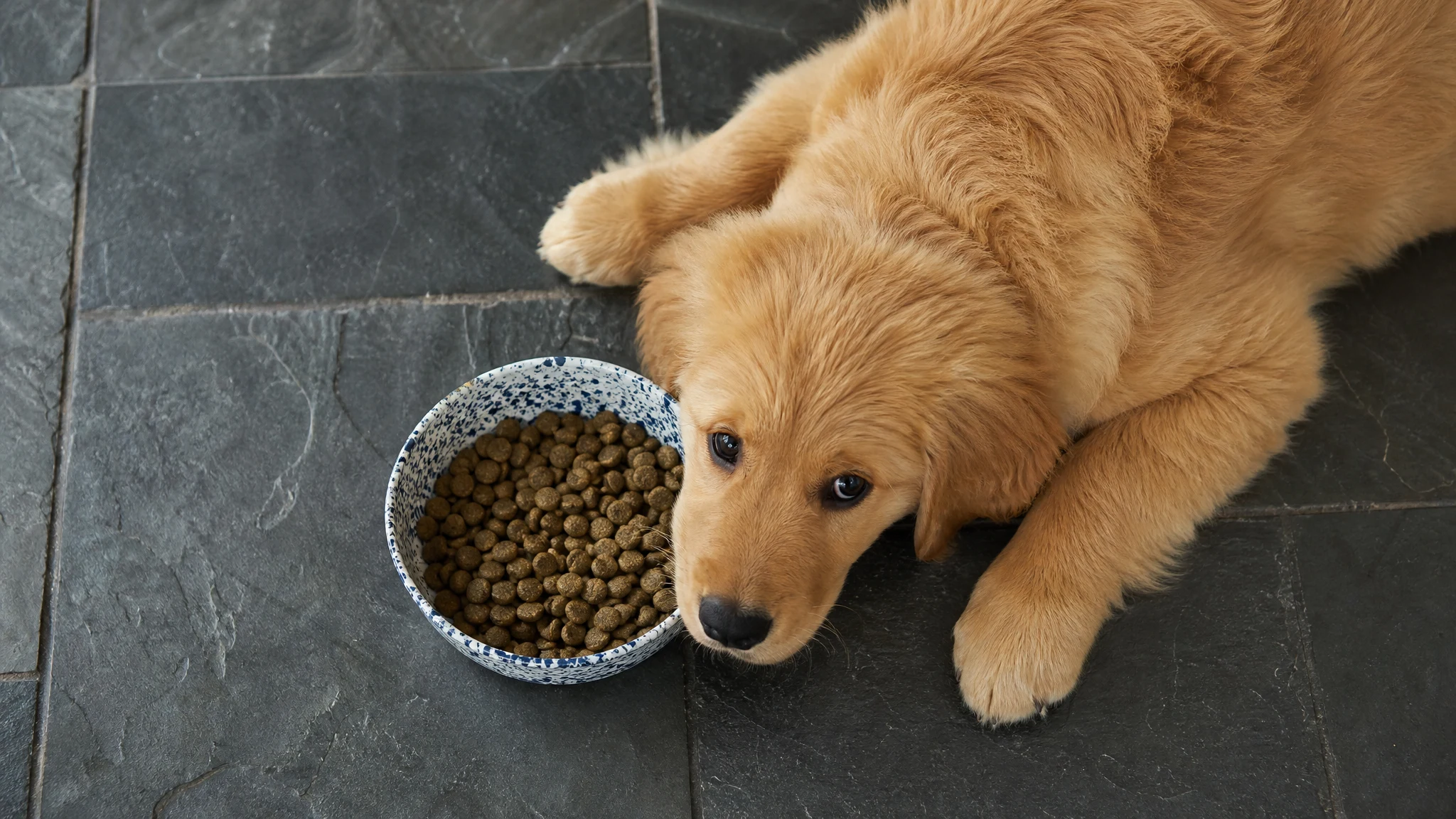
General nutrition information compiled from product labels and published sources, not veterinary advice. Your veterinarian is the right person to choose a diet for your dog, especially one with a health condition.
Most bags say little about kibble size. Many give no measurements at all. Still, the size and shape of each piece matter for a young Golden Retriever who is learning to eat from a bowl.
This guide shows how to check golden retriever kibble for fit, and how to compare puppy formulas on the label data brands actually publish. We compared label data only. We did not run feeding trials or taste tests, and we did not measure any kibble ourselves.
Why kibble size is only part of the picture
A Golden Retriever is a large breed. The Golden Retriever Club of America breed standard lists adult males at 65 to 75 pounds and females at 55 to 65 pounds. A puppy that will reach that size has different growth needs than a toy breed puppy.
Kibble size is a handling question: can your puppy pick up, chew and swallow the piece comfortably? Nutrition is a separate question. A piece that fits well in the mouth is no help if the formula is wrong for a growing large-breed dog. So fit is a second check, after the nutrition basics.
What you need
- The bag or the brand's product page for each food you are considering
- A pen and paper, or a simple notes file, to record label data
- A kitchen scale that reads in grams
- A small sample or trial bag, if the brand or your store offers one
- A shallow, non-slip bowl
- Your veterinarian's contact details, for questions about your own puppy
Step 1: Start with the nutrition statement, not the kibble
Find the AAFCO nutritional adequacy statement on the label. For foods that claim growth or all life stages, the statement must end in one of two ways. It says either "including growth of large size dogs (70 lb. or more as an adult)" or "except for growth of large size dogs (70 lb. or more as an adult)." This wording comes from the AAFCO model adopted in Washington Administrative Code 16-252-044.
For a Golden Retriever puppy, the "including" version is the one to look for. Cornell University College of Veterinary Medicine advises a diet formulated for large breeds while puppies are growing. It also lists Golden Retrievers as a predisposed breed for panosteitis, and recommends a commercial large-breed puppy diet formulated to an AAFCO growth statement.
If a food fails this check, its kibble size does not matter. Move on.
Step 2: Find out what the brand actually says about kibble size
Open each brand's product page and look for kibble size. Write down exactly what is stated. In the foods we compared, the picture is thin:
- Royal Canin Golden Retriever Puppy describes a breed-shaped kibble but gives no dimensions.
- Victor Classic Hi-Pro Plus Large Breed Puppy says it has an "appropriate kibble size" for large breeds, with no dimensions.
- Royal Canin Large Puppy and Hill's Science Diet Puppy Large Breed do not state a kibble size on the pages we opened.
If a number matters to you, ask the brand directly. Do not guess from a photo. Do not trust a reviewer's estimate either.
Step 3: Compare the label data side by side
Put the numbers in one table. Use the same basis for each food. Hill's publishes dry matter averages rather than minimums, so those figures are not directly comparable to the others.
| Food | Growth statement | Protein | Fat | kcal per cup | Kibble size |
|---|---|---|---|---|---|
| Royal Canin Golden Retriever Puppy | Not found on the page we opened | 27% min | 14% min | 339 | Breed-shaped, no dimensions |
| Royal Canin Large Puppy | Growth, including large size dogs | 28% min | 14% min | 349 | Not stated |
| Hill's Science Diet Puppy Large Breed | AAFCO feeding tests, growing puppies | 26.7% (dry matter avg) | 15.4% (dry matter avg) | 387 | Not stated |
| Victor Classic Hi-Pro Plus Large Breed Puppy | All life stages, also covers growth of large dogs | 30% min | 14% min | 365 | "Appropriate" for large breeds, no dimensions |
Calcium is not published on the pages we opened, so it is not in the table. Ask the brand for it, or ask your veterinarian. Also note that the Royal Canin Golden Retriever Puppy page did not show a growth statement. Check the bag in your hands before you decide.
For a full comparison, see our ranked guide to puppy food for Golden Retriever puppies.
Step 4: Do a simple fit check at home
Once a food passes the nutrition check, get a small amount and watch your puppy eat it. You are looking for a few easy signs:
- The puppy picks pieces up without dropping many.
- The puppy chews at least a few times before swallowing.
- The puppy does not gag, cough or choke.
- The puppy does not regularly spit pieces back out.
If your puppy gulps whole pieces, try a shallow bowl with a wide base so the food spreads out. Do not switch to a different food just because of gulping. Talk to your veterinarian first.
Any sign of choking or repeated gagging is a reason to call your veterinarian promptly.
Step 5: Weigh the food and treat the label as a starting point
Royal Canin notes on its Golden Retriever puppy page that its feeding guide is only a guide, and that grams are the most accurate form of measurement. Cups are approximate. Hill's says to adjust amounts as needed to maintain optimal weight, and to ask your veterinarian if you are unsure.
Weigh each meal in grams. Use the label as a starting point, then adjust with your veterinarian as your puppy grows.
Cornell advises avoiding overfeeding and rapid growth in large-breed puppies, and also says not to supplement growing puppies with calcium and vitamin D. Calories per cup differ between foods. In the table above, the range runs from 339 to 387 kcal per cup. The same cup of two different foods is not the same meal.
Step 6: Switch foods slowly and keep notes
If you change foods, do it over several days. Mix a little of the new food into the old, and increase the new share gradually. Keep a short log of appetite, stool and how your puppy handles the pieces. Bring it to your next vet visit.
Keep feeding a large-breed puppy formula until your veterinarian says to change. PetMD suggests this is usually somewhere between 12 and 18 months for a Golden Retriever.
Tips
- Choose the formula first, then the kibble size. Never the other way around.
- Ask the brand for kibble dimensions if you want them. Many pages do not list any.
- Do not soften kibble to "fix" a poor fit without asking your veterinarian. It changes how you measure and how your puppy chews.
- Re-weigh your puppy regularly. Feeding needs change quickly during growth.
- Look at the first ingredients too. They tell you what the food is mostly made from, but not whether it suits your puppy.
Common mistakes to avoid
- Assuming "breed-specific" means a better fit. A breed name on the bag is marketing until you check the AAFCO statement and the label data.
- Buying a standard puppy formula for a large-breed puppy. Hill's standard Puppy Chicken & Brown Rice page makes no large-breed claim. Its large breed formula is the closer match for a Golden Retriever.
- Comparing different bases. Minimum percentages and dry matter averages are not the same measurement.
- Judging by cups alone. Cups vary with kibble shape and density.
- Adding calcium or other supplements to a growing puppy. Cornell advises against calcium and vitamin D supplements for growing puppies.
- Expecting food to fix a health condition. Diet and growth rate matter for joint development, according to Cornell. A veterinarian decides what is right for an individual dog, and prescription diets come only from a veterinarian.
What results to expect
A well-fitting kibble may make mealtimes calmer and less messy. Many puppies handle appropriately sized pieces with less dropping and gulping. Results vary from dog to dog.
A food with a large-breed growth statement and a sensible feeding plan may help support steady, moderate growth. It will not guarantee any health outcome. Weight checks and regular veterinary visits are what tell you how your puppy is really doing.
If a food does not suit your puppy, you may see loose stools, poor appetite or constant drooling at the bowl. Call your veterinarian rather than trying one product after another.
Quick checklist
- Confirm the growth statement includes large size dogs.
- Record protein, fat, kcal and kibble size from the brand page.
- Ask the brand about anything not published, such as calcium or dimensions.
- Test a small amount and watch how your puppy eats.
- Weigh meals in grams and adjust with your veterinarian.
Sources
- Golden Retriever Club of America, Official Standard of the Golden Retriever
- Cornell University College of Veterinary Medicine, Canine hip dysplasia (CHD)
- Cornell University College of Veterinary Medicine, Panosteitis in dogs
- Washington Administrative Code 16-252-044, via Cornell LII
- PetMD, Golden Retriever Dog Breed Health and Care
- Royal Canin, Golden Retriever Puppy product page
- Royal Canin, Large Puppy product page
- Hill's Pet Nutrition, Science Diet Puppy Large Breed
- Victor Super Premium Pet Food, Hi-Pro Plus Large Breed Puppy